
Explain an API with success and failure paths
Map a request and response without exposing credentials or inventing a service’s internals.
35 minutes estimated—not learner-validated. Original learning materials are free; optional external AI access may require an account, credits or payment.
Start the editable activity →No account needed to begin. Explicit account saving and editable offline export are available in the workspace.
New here? Try the three-activity starter ↗
Why this matters
An API is an agreed interface, not a window into every internal system. Use an invented service so you can distinguish the known contract from implementation guesses. Include authentication, permissions, status codes, rate limits and data minimization. A diagram is not a connected API call.
Before you start
Materials are free. External tools may require an adult account, credits, regional eligibility or a paid plan. Check current terms before using them. Do not paste passwords, API keys, private messages or other people’s personal data. No model runs locally or downloads automatically on this platform.
Your illustrated field guide
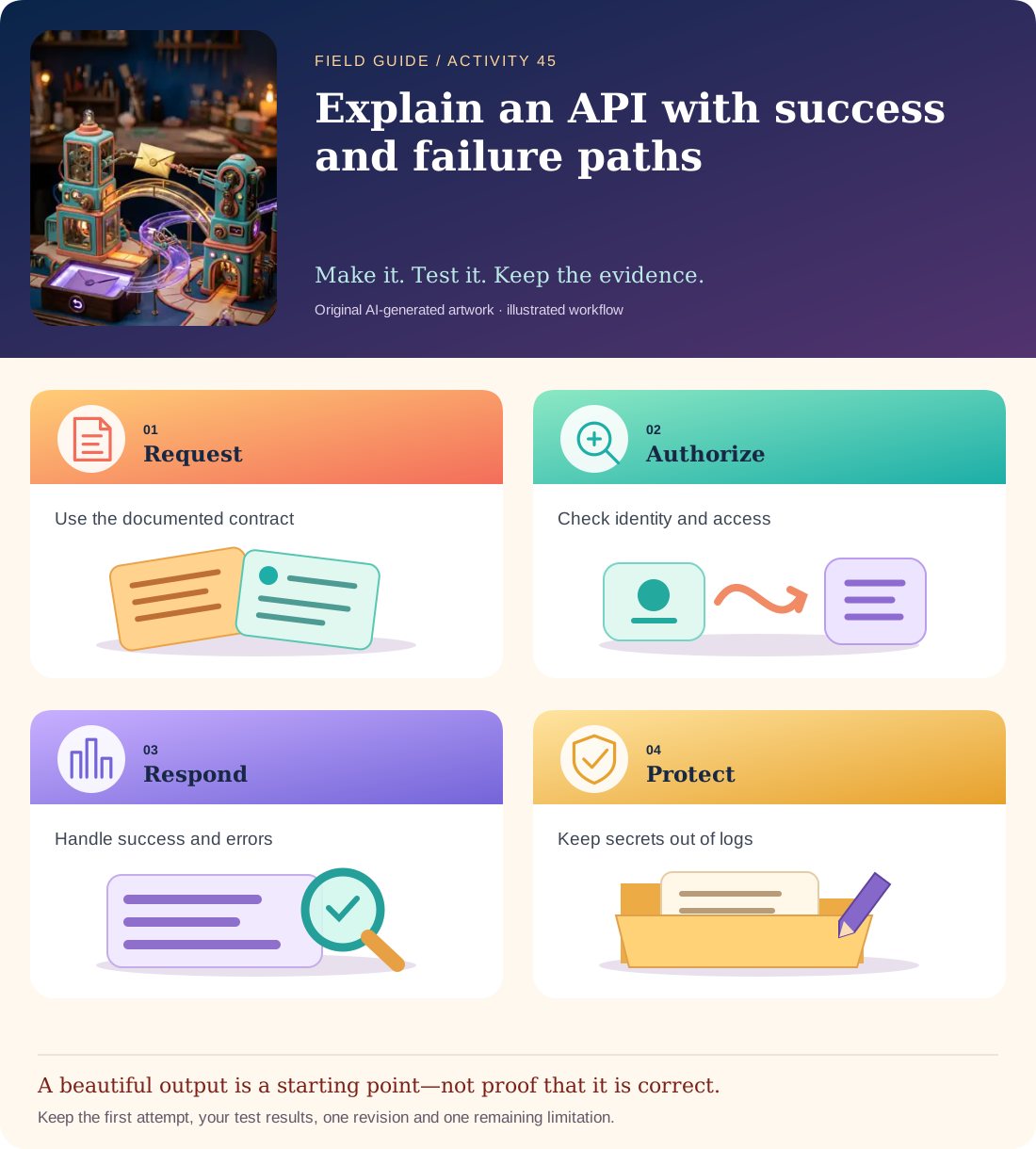
Conceptual illustration, not a provider screenshot. Artwork is AI-generated; instructional labels are authored text.
Start with fictional input
Fictional contract: GET /playlists/p01 with a valid authorized token returns {"id":"p01","tracks":["t01","t02"]}. Missing/invalid token → 401. Valid token without access → 403. Missing playlist → 404. Too many requests → 429 with a retry hint. No real service or credential is involved.Copy and adapt this prompt
Explain this fictional API in plain language as a request/response flow. Include the five outcomes, what the client should display and what it must not log. Distinguish authentication from permission. Do not invent a real music service’s endpoints or internal architecture.
Worked reference—not proof of correctness
401 means credentials are missing/invalid; 403 means the supplied identity lacks access. A 429 should not trigger an endless tight retry loop. Tokens belong in protected request handling, not screenshots, URLs, analytics or shared exercise notes.
Five practical steps
Read the contract
Separate endpoint, method, credentials, allowed response fields and status codes.
Build a success flow
Trace the fictional mobile app’s request and the returned track IDs.
Add the four failure routes
Write a safe message and next action for 401, 403, 404 and 429.
Minimize the log
Keep status, timing and a non-secret request ID; omit tokens and unnecessary personal data.
Teach it back
Explain the difference between authentication and permission using the two relevant statuses.
Test your result
- Success and all four failure outcomes appear in the flow.
- 401 and 403 are distinguished and rate limiting has a bounded retry/wait policy.
- The artifact is labelled a contract simulation and contains no real tokens or invented live endpoints.
Mistakes to watch for
- Confusing a valid login with permission to read every resource.
- Putting API keys in query strings or shared screenshots.
Offline / no-key route
Move request/status cards through the flow and explain the client’s next action for each.
Reflect
Which error should lead to a permission review rather than another login attempt?
Keep your notes, tests and self-review →Self-reported practice is not independent assessment or a qualification. Browse all 50 guides · Choose a tool