
One fact set, three audiences
Change tone and emphasis without changing dates, responsibility or uncertainty.
35 minutes estimated—not learner-validated. Original learning materials are free; optional external AI access may require an account, credits or payment.
Start the editable activity →No account needed to begin. Explicit account saving and editable offline export are available in the workspace.
New here? Try the three-activity starter ↗
Why this matters
Different readers need different levels of detail, but tone adaptation must not hide a problem or create a promise. Freeze a small fact ledger first. Compare each version against the same ledger and look for omissions that would change a decision. Fictional delays avoid exposing real client information.
Before you start
Materials are free. External tools may require an adult account, credits, regional eligibility or a paid plan. Check current terms before using them. Do not paste passwords, API keys, private messages or other people’s personal data. No model runs locally or downloads automatically on this platform.
Your illustrated field guide
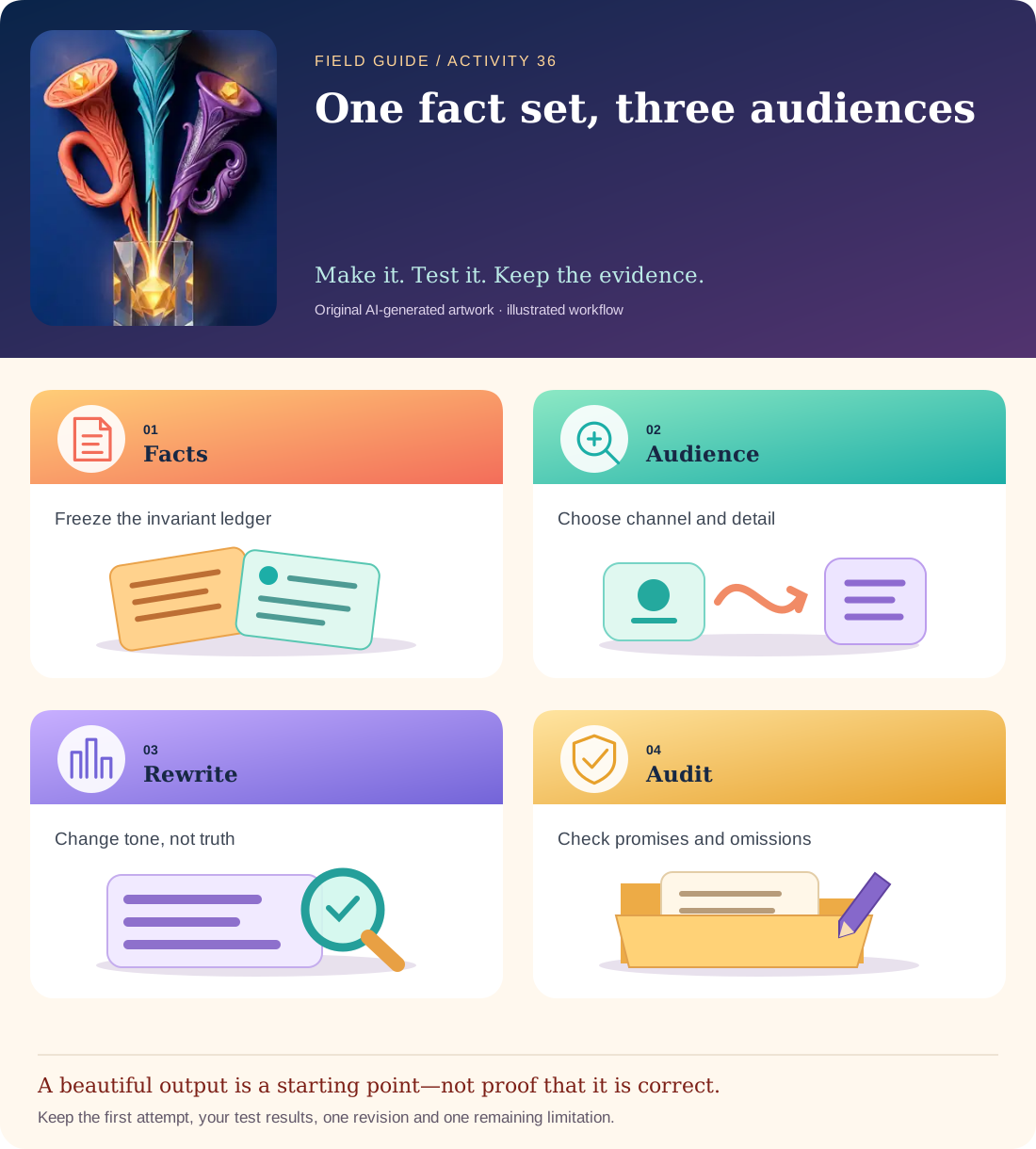
Conceptual illustration, not a provider screenshot. Artwork is AI-generated; instructional labels are authored text.
Start with fictional input
Facts: a prototype review planned for Tuesday is delayed because two checks failed. The team will provide a revised estimate on Thursday. No new completion date is approved. The client has not agreed to additional cost.
Copy and adapt this prompt
Write three versions from the same facts: a concise teammate chat, a professional client email and a two-sentence executive update. Preserve the failed checks, Thursday estimate update and lack of an approved completion date. Do not promise Thursday delivery, blame an individual or imply extra cost approval.
Worked reference—not proof of correctness
Client-safe wording: “Two checks remain unresolved, so Tuesday’s review cannot proceed. We will share a revised estimate on Thursday; a new completion date is not yet confirmed.” “We will deliver Thursday” changes the facts.
Five practical steps
Freeze the ledger
Write the four invariant facts before generating any tone variation.
Produce three drafts
Name channel, audience and length rather than asking for increasingly persuasive versions.
Check each invariant
Use a small table with one column per audience and one row per fact.
Inspect softened wording
Look for euphemisms that conceal failed checks or turn an estimate into a commitment.
Edit for accountability
Keep a clear next update and a truthful unresolved status in the final drafts.
Test your result
- All three drafts preserve the same dates, unresolved status and cost boundary.
- Thursday is an estimate update, not a promised delivery.
- Tone changes do not introduce blame, approval or new business commitments.
Mistakes to watch for
- Making an executive summary so short that it hides a material risk.
- Turning a reassuring tone into a false promise.
Offline / no-key route
Write the three channel versions manually and compare them with the fact ledger.
Reflect
Which audience version came closest to hiding a fact that mattered?
Keep your notes, tests and self-review →Self-reported practice is not independent assessment or a qualification. Browse all 50 guides · Choose a tool