
From voice memo to accountable actions
Separate transcription errors from action-item extraction errors.
45 minutes estimated—not learner-validated. Original learning materials are free; optional external AI access may require an account, credits or payment.
Start the editable activity →No account needed to begin. Explicit account saving and editable offline export are available in the workspace.
New here? Try the three-activity starter ↗
Why this matters
Speech-to-text and summarization are two different stages, each with failure modes. Preserve the transcript before summarizing it, and do not let a model invent an owner or deadline. Use only your own consented recording; a supplied fictional transcript lets you practise without uploading audio.
Before you start
Materials are free. External tools may require an adult account, credits, regional eligibility or a paid plan. Check current terms before using them. Do not paste passwords, API keys, private messages or other people’s personal data. No model runs locally or downloads automatically on this platform.
Your illustrated field guide
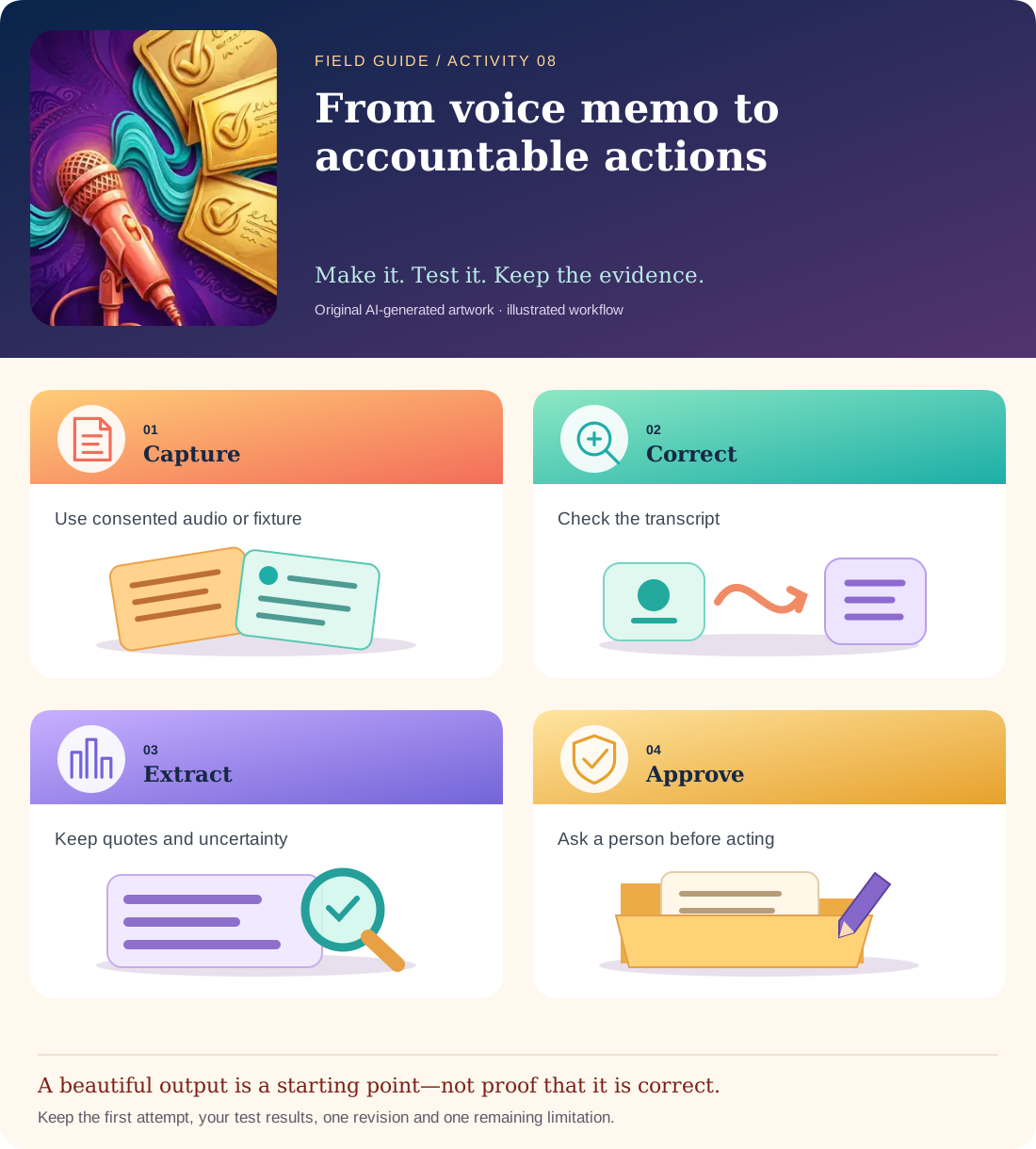
Conceptual illustration, not a provider screenshot. Artwork is AI-generated; instructional labels are authored text.
Start with fictional input
Fictional transcript: “Let’s try a pop-up repair table. Nia can ask the venue by Friday. We still need someone to check insurance. Maybe Saturday the 14th, but do not announce it yet. Tari will list tools. There is no tool deadline agreed. Keep the first budget under $80.”
Copy and adapt this prompt
Extract an action table from this transcript: action, owner, deadline, certainty, exact supporting quote. Use Not assigned or Not agreed where appropriate. Keep proposed dates separate from approved decisions. Do not turn the budget limit into permission to spend.
Worked reference—not proof of correctness
Venue inquiry | Nia | Friday | agreed | “Nia can ask the venue by Friday.” Insurance check | Not assigned | Not agreed | open. Saturday the 14th is proposed, not an announcement instruction. Tari owns the tool list, but its deadline is not agreed.
Five practical steps
Record or use the fixture
If recording, make a short memo using invented project details and no third-party voices.
Review transcription first
Compare the transcript to the audio, especially names, negation, numbers and dates. Note corrections.
Extract structured actions
Use the prompt and retain a supporting quote for each row.
Audit omissions and inventions
Check unassigned insurance, the tentative event date and Tari’s missing deadline.
Prepare a review message
Write two clarifying questions a human must answer before publishing or spending.
Test your result
- Each action has a transcript quote; unspecified owners/deadlines remain explicitly unspecified.
- The proposed event date is not presented as approved.
- Transcription corrections and summarization corrections are logged separately.
Mistakes to watch for
- Uploading someone else’s meeting without permission.
- Replacing “not agreed” with a plausible-sounding deadline.
Offline / no-key route
Use the supplied transcript and build the action table manually. This tests extraction, not transcription.
Reflect
Was your biggest error in hearing the words or interpreting the commitment?
Keep your notes, tests and self-review →Self-reported practice is not independent assessment or a qualification. Browse all 50 guides · Choose a tool