
Find connections without inventing history
Distinguish an analogy, a documented influence and a factual relationship.
35 minutes estimated—not learner-validated. Original learning materials are free; optional external AI access may require an account, credits or payment.
Start the editable activity →No account needed to begin. Explicit account saving and editable offline export are available in the workspace.
New here? Try the three-activity starter ↗
Why this matters
An unexpected connection is an idea to investigate, not evidence that one system caused another. Separate analogy from history and verify specific claims independently. The Roman Empire and cloud computing can invite useful comparisons, but modern technical terms should not be projected backward as literal ancient systems.
Before you start
Materials are free. External tools may require an adult account, credits, regional eligibility or a paid plan. Check current terms before using them. Do not paste passwords, API keys, private messages or other people’s personal data. No model runs locally or downloads automatically on this platform.
Your illustrated field guide
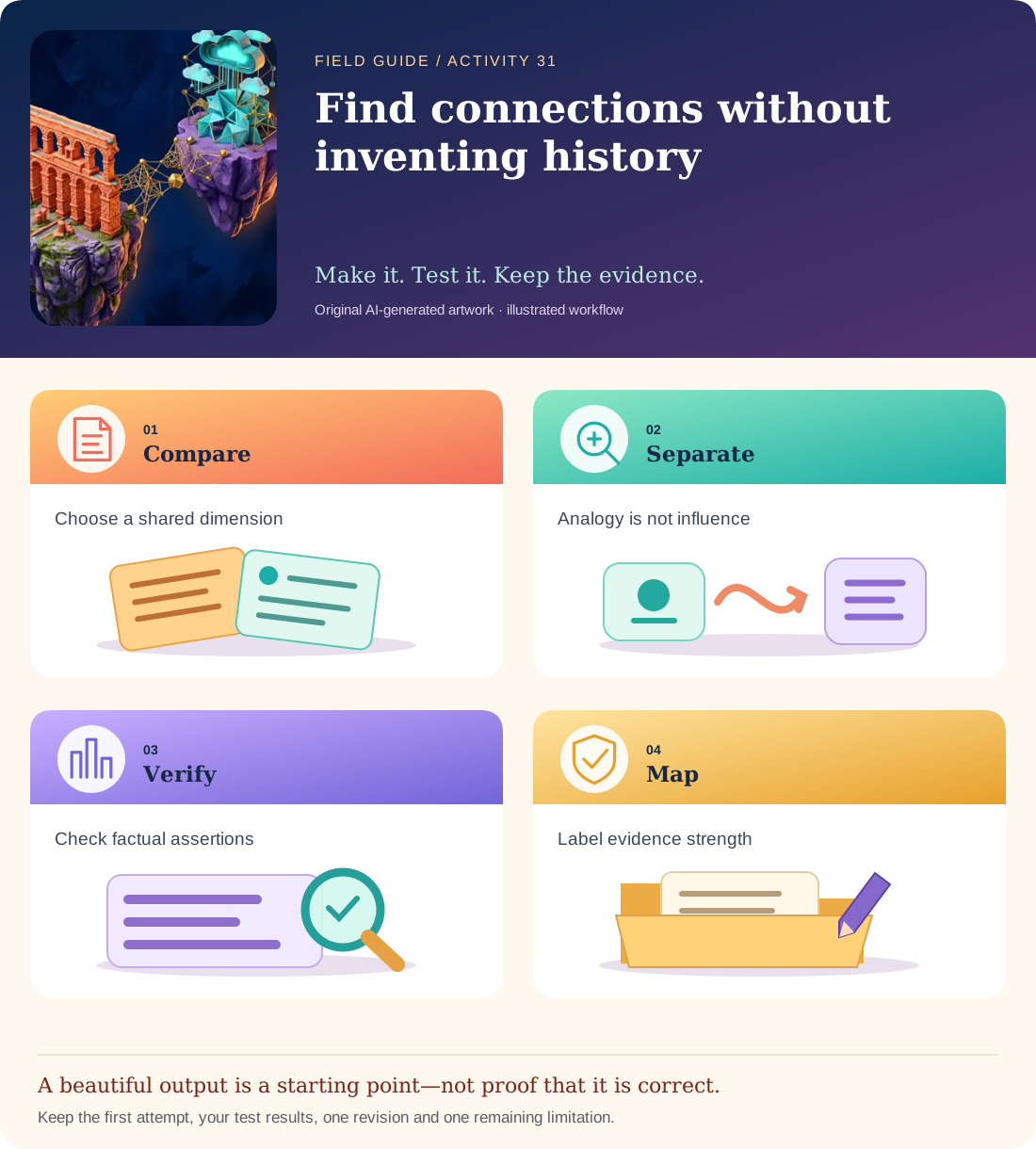
Conceptual illustration, not a provider screenshot. Artwork is AI-generated; instructional labels are authored text.
Start with fictional input
Compare a Roman road network with a modern distributed computing network. Possible dimensions: routes, hubs, disruption, maintenance and administration. No historical document or technical specification is supplied.
Copy and adapt this prompt
Suggest three clearly labelled ANALOGIES between these systems. For each, explain one useful comparison and one important difference. Put historical or technical factual claims in a separate verification-needed list. Do not invent direct influence, quotations or ancient equivalents of digital technology.
Worked reference—not proof of correctness
Analogy: both can involve alternative routes around disruption. Difference: roads transport physical travellers/goods; computer networks move encoded information under protocols. “Romans invented cloud load balancing” is not an acceptable factual conclusion.
Five practical steps
Name relationship types
Define analogy, factual claim and causal influence before querying.
Generate three candidates
Ask for useful similarities plus differences, not a sensational hidden-history narrative.
Tag each sentence
Mark it analogy, factual assertion or unsupported causal claim.
Verify one assertion
Consult an authoritative historical or technical source and record the exact supporting passage.
Build a cautious map
Use solid edges for verified relationships and dashed edges for analogies or hypotheses.
Test your result
- Each connection is labelled by type and includes an explicit difference.
- At least one factual assertion has independently checked evidence or remains unresolved.
- No analogy is reported as proof of historical influence.
Mistakes to watch for
- Mistaking a clever parallel for causation.
- Inventing citations to make a surprising story sound credible.
Offline / no-key route
Compare two familiar systems on paper and label the analogy boundaries without making historical claims.
Reflect
Which connection stayed useful after you removed its exaggerated historical claim?
Keep your notes, tests and self-review →Self-reported practice is not independent assessment or a qualification. Browse all 50 guides · Choose a tool