
Stress-test an argument politely
Use counterarguments to find assumptions, not to outsource your judgement.
35 minutes estimated—not learner-validated. Original learning materials are free; optional external AI access may require an account, credits or payment.
Start the editable activity →No account needed to begin. Explicit account saving and editable offline export are available in the workspace.
New here? Try the three-activity starter ↗
Why this matters
An AI opponent can generate plausible objections but may invent evidence. Define the claim narrowly, separate empirical statements from values and ask what evidence would change each side’s view. A useful debate ends with a revised claim or a better question, not a manufactured winner.
Before you start
Materials are free. External tools may require an adult account, credits, regional eligibility or a paid plan. Check current terms before using them. Do not paste passwords, API keys, private messages or other people’s personal data. No model runs locally or downloads automatically on this platform.
Your illustrated field guide
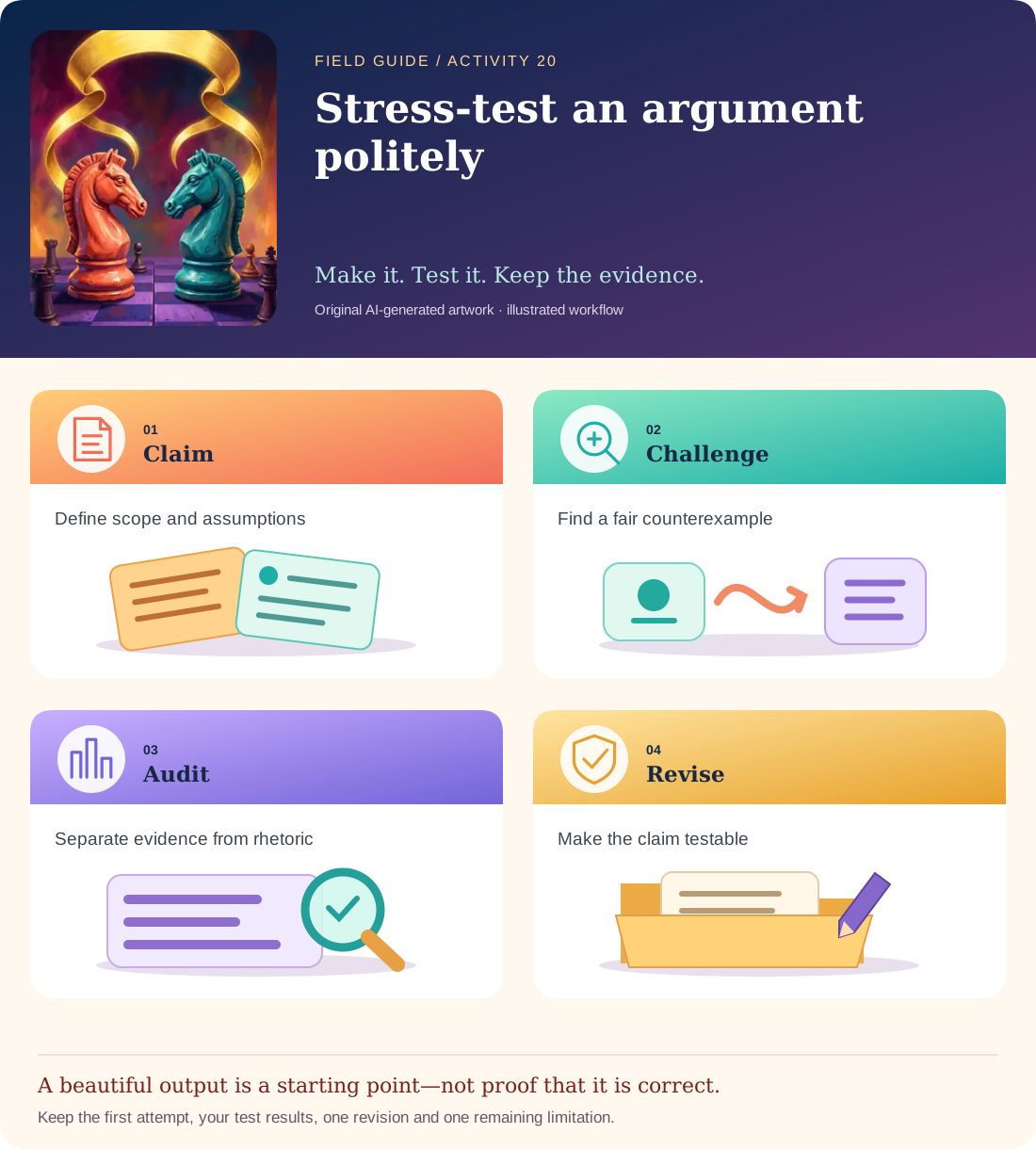
Conceptual illustration, not a provider screenshot. Artwork is AI-generated; instructional labels are authored text.
Start with fictional input
Claim: “Remote work is always better than office work.” Context: a fictional eight-person design team; two members need physical workshop equipment, three prefer quiet home working, and the team has missed two handovers. No productivity study is supplied.
Copy and adapt this prompt
Challenge the word “always” in this claim using only the supplied context. Give one strongest counterexample, one assumption to test and one fair question. Do not fabricate studies or diagnose people. After I answer, help me rewrite a narrower, testable claim.
Worked reference—not proof of correctness
Counterexample: equipment-dependent tasks may require a shared workshop. Revised claim: for suitable desk tasks, a hybrid arrangement might help this team if handover reliability is maintained. That is a proposal to test, not a proven productivity result.
Five practical steps
State the claim
Mark absolute words and define which team and tasks you mean.
Request a steelman objection
Ask for the strongest reasonable counterexample rather than insults or rhetorical tricks.
Audit evidence
Label each statement source-supported, hypothetical or unsupported; remove fabricated study references.
Answer one question
Explain which trade-off matters most and what measurement you would accept.
Revise and plan a test
Write a narrower claim and two measures, such as handover completion and task cycle time.
Test your result
- The objection targets an identifiable assumption rather than the speaker.
- No invented study or unsupported productivity number is accepted as evidence.
- The final claim has a scope and a plausible way to test it.
Mistakes to watch for
- Equating persuasive language with a true counterargument.
- Treating the exercise as a competition to “destroy” an opponent.
Offline / no-key route
Write the strongest objection yourself, then ask a partner to improve it respectfully.
Reflect
What evidence could genuinely make you change your mind?
Keep your notes, tests and self-review →Self-reported practice is not independent assessment or a qualification. Browse all 50 guides · Choose a tool