
Test visible-expression labels
Build a labelled image test and distinguish an expression from a person’s emotion or identity.
45 minutes estimated—not learner-validated. Original learning materials are free; optional external AI access may require an account, credits or payment.
Start the editable activity →No account needed to begin. Explicit account saving and editable offline export are available in the workspace.
New here? Try the three-activity starter ↗
Why this matters
A smile is an observable expression, not proof that someone is happy. This activity defaults to a hosted vision model classifying a small test set; that does not train a new model. If you have a supported hosted no-code trainer, record that separate route explicitly. Faces are optional: use simple expression cards instead.
Before you start
Materials are free. External tools may require an adult account, credits, regional eligibility or a paid plan. Check current terms before using them. Do not paste passwords, API keys, private messages or other people’s personal data. No model runs locally or downloads automatically on this platform.
Your illustrated field guide
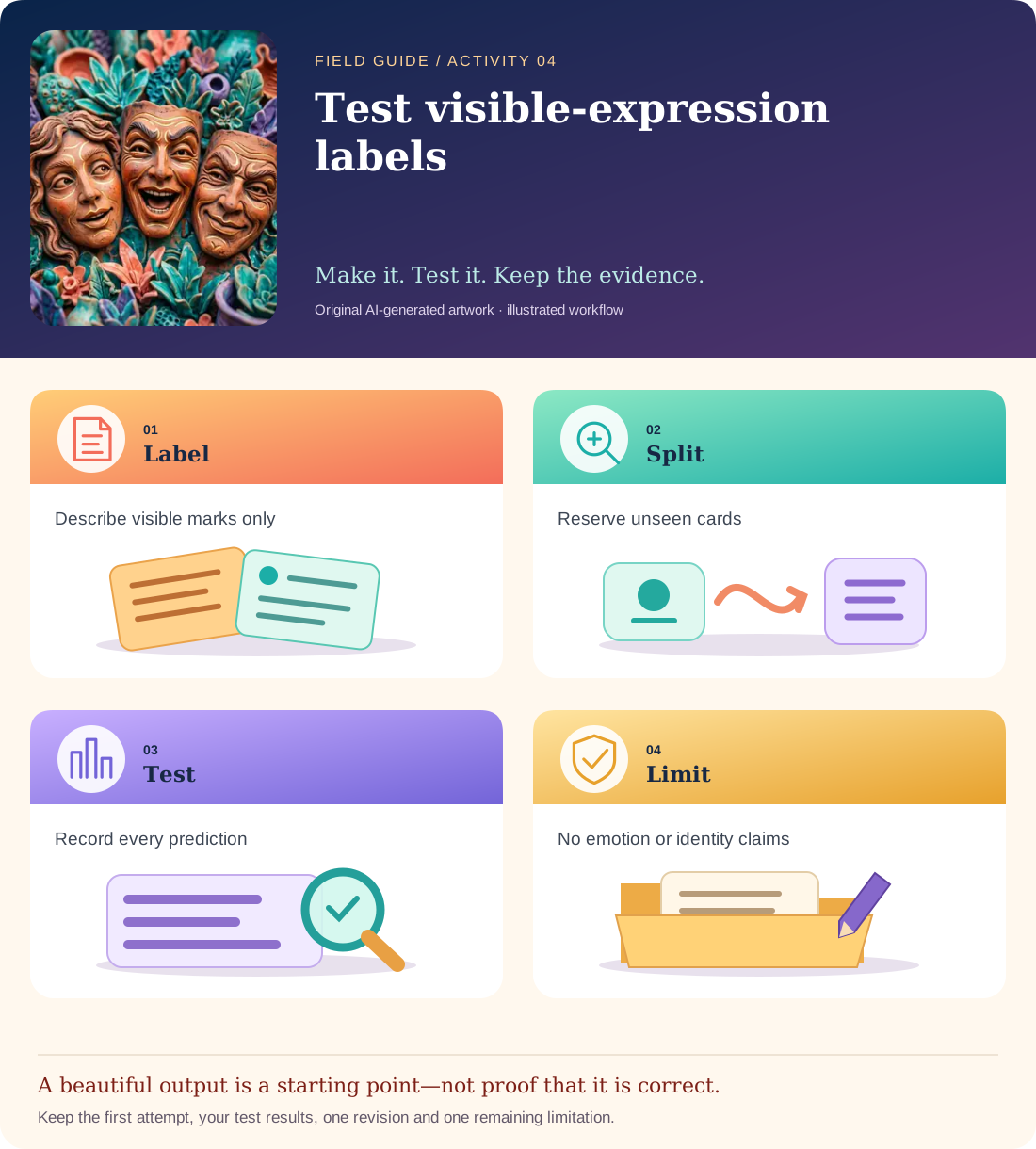
Conceptual illustration, not a provider screenshot. Artwork is AI-generated; instructional labels are authored text.
Start with fictional input
Make six original drawing cards: two with an upward-curved mouth, two with a straight mouth and two ambiguous/partly covered. Use labels Smile visible, Straight mouth visible, and Unclear. Reserve one of each for testing. Do not photograph another person.
Copy and adapt this prompt
Classify the visible mouth shape in this original card as Smile visible, Straight mouth visible or Unclear. Give one short observation about the visible marks. Do not infer identity, feelings, health, personality or protected characteristics. If hidden or ambiguous, choose Unclear.
Worked reference—not proof of correctness
An upward curve may support “Smile visible; the mouth curves upward.” A covered mouth should produce Unclear. “This person is happy and trustworthy” fails the task, even if the picture is smiling.
Five practical steps
Build the cards
Create balanced labels and include ambiguity; keep the held-out cards separate from any examples.
Choose your route
Use a hosted vision tool with upload permission. If using a hosted trainer, record training settings; otherwise label the run pretrained classification.
Test new views
Upload held-out cards one at a time. Record expected label, actual label and visible evidence.
Stress the boundary
Rotate or partly cover a card. Observe whether the tool overclaims or admits uncertainty.
Document limitations
Report the number correct out of the number tested. Do not generalize a tiny drawing-card test to real people.
Test your result
- The run log states whether custom training happened or only pretrained classification.
- All three held-out labels are recorded, including unclear cases; errors remain visible.
- No output is accepted as evidence of a person’s emotion, identity or trustworthiness.
Mistakes to watch for
- Uploading faces without consent or using expression labels for surveillance.
- Calling the result a trained emotion detector.
Offline / no-key route
Use the supplied label sheet and ask a human to classify held-out drawing cards. Save a dataset/test plan and mark it “not model-tested.”
Reflect
What can your labels establish, and what can they never establish about a real person?
Keep your notes, tests and self-review →Self-reported practice is not independent assessment or a qualification. Browse all 50 guides · Choose a tool