
Build an FAQ from unanswered questions
Anticipate difficult questions without inventing policies or reassuring answers.
35 minutes estimated—not learner-validated. Original learning materials are free; optional external AI access may require an account, credits or payment.
Start the editable activity →No account needed to begin. Explicit account saving and editable offline export are available in the workspace.
New here? Try the three-activity starter ↗
Why this matters
A skeptical question is useful only if the answer is honest. Separate known policy, missing policy and a question that needs user research. The model can propose friction points; it cannot authorize refunds, privacy practices or support promises. Build a review queue before publishing anything.
Before you start
Materials are free. External tools may require an adult account, credits, regional eligibility or a paid plan. Check current terms before using them. Do not paste passwords, API keys, private messages or other people’s personal data. No model runs locally or downloads automatically on this platform.
Your illustrated field guide
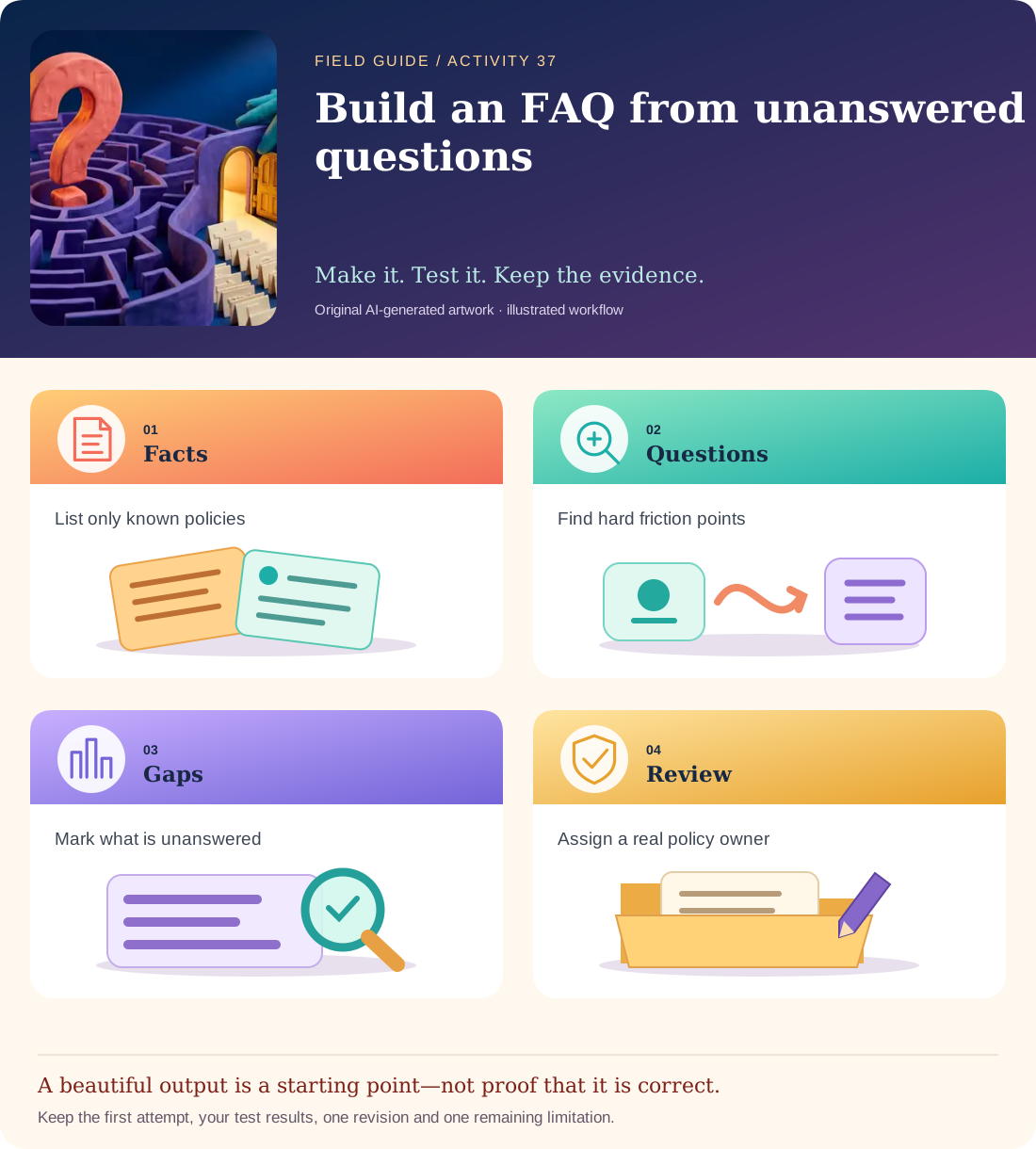
Conceptual illustration, not a provider screenshot. Artwork is AI-generated; instructional labels are authored text.
Start with fictional input
Fictional service: a community tool-lending desk opens Saturdays. Borrowing is limited to seven days. Members collect tools in person. Deposit, damage, identity-check, data-retention and cancellation policies have not been decided.
Copy and adapt this prompt
Generate seven difficult customer questions. For each, label Answer supported, Policy missing or Needs research, cite the supplied fact if present, and draft only an honest placeholder where policy is unknown. Do not promise free replacements, no deposits, privacy guarantees or always-available stock.
Worked reference—not proof of correctness
“How long may I borrow a tool?” → Answer supported: seven days. “What if it breaks?” → Policy missing: do not publish a liability or replacement promise. “Can I get a tool today?” → check Saturday opening and actual availability.
Five practical steps
List known policies
Keep the three supplied facts separate from everything still undecided.
Generate the hard questions
Include cost, damage, access, privacy, availability and cancellation.
Classify answerability
Match each answer to a source fact or mark the gap visibly.
Create a policy queue
Assign an owner and review status to each missing policy rather than filling it with AI guesses.
Test the FAQ draft
Ask a reader which answers could cause a mistaken expectation or commitment.
Test your result
- Exactly seven questions cover distinct practical concerns.
- Unsupported policies remain explicitly unresolved and are not published as promises.
- A review queue identifies who must supply and approve each missing answer.
Mistakes to watch for
- Treating a generated FAQ as an approved service policy.
- Writing reassuring answers before the business has made the decision.
Offline / no-key route
Draft questions with a partner and sort them into supported/missing/research-needed piles.
Reflect
Which tempting answer would accidentally commit the service to something it has not approved?
Keep your notes, tests and self-review →Self-reported practice is not independent assessment or a qualification. Browse all 50 guides · Choose a tool