
Classify feedback with an uncertainty bucket
Create a small labelled feedback set and inspect false positives.
35 minutes estimated—not learner-validated. Original learning materials are free; optional external AI access may require an account, credits or payment.
Start the editable activity →No account needed to begin. Explicit account saving and editable offline export are available in the workspace.
New here? Try the three-activity starter ↗
Why this matters
Sentiment is not the same as topic or urgency. A short review can contain praise and criticism at once; forcing it into a single emotional label hides information. Define an explicit Mixed/Unclear route and quote the relevant text instead of guessing a customer’s feelings.
Before you start
Materials are free. External tools may require an adult account, credits, regional eligibility or a paid plan. Check current terms before using them. Do not paste passwords, API keys, private messages or other people’s personal data. No model runs locally or downloads automatically on this platform.
Your illustrated field guide
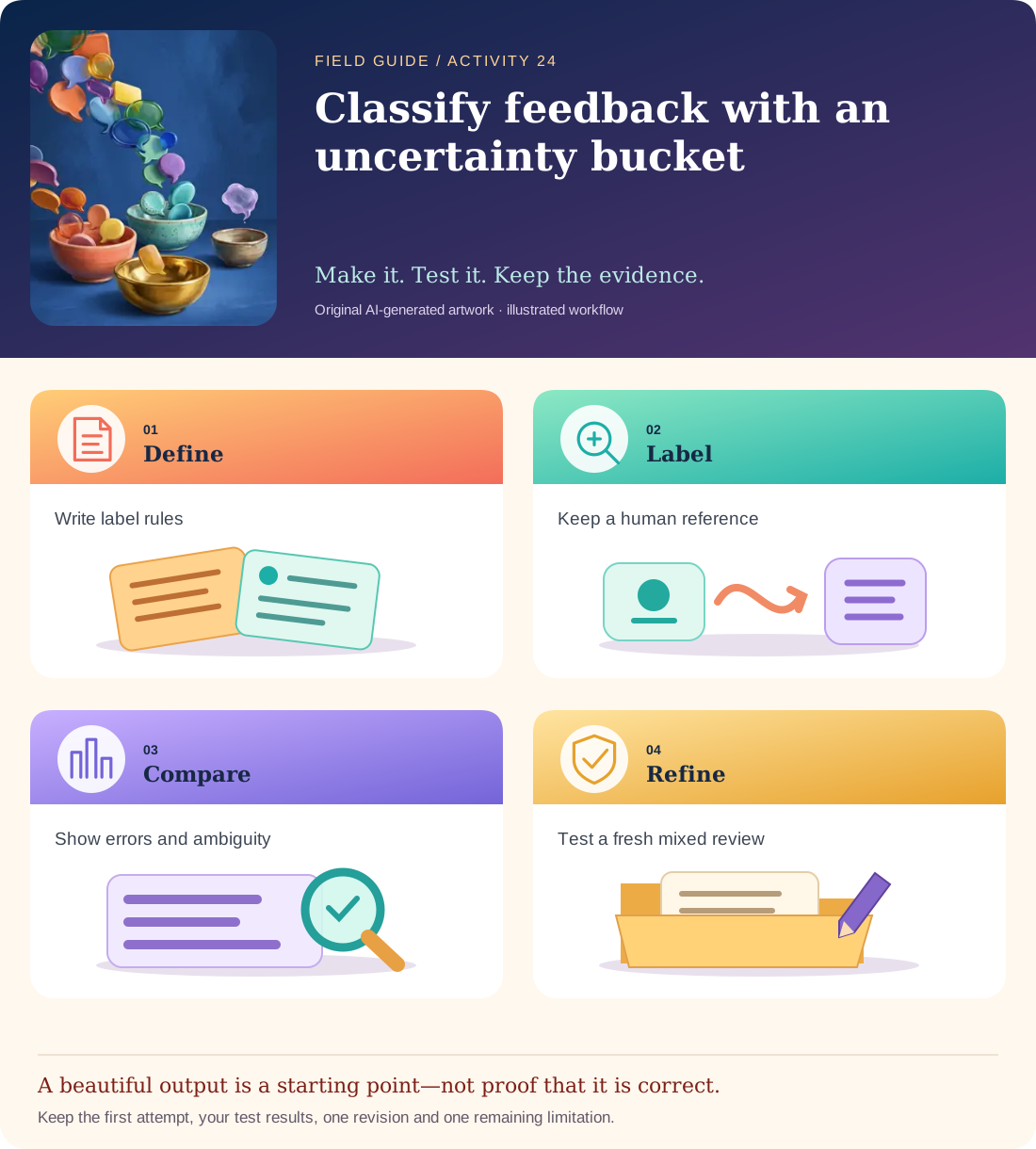
Conceptual illustration, not a provider screenshot. Artwork is AI-generated; instructional labels are authored text.
Start with fictional input
r1: “Arrived early. Excellent.” r2: “It is a mug.” r3: “The handle broke immediately.” r4: “Looks lovely, but the lid leaks.” r5: “Great, another week waiting.” Labels: Positive, Neutral, Negative, Mixed/Unclear.
Copy and adapt this prompt
Classify each review by ID using the defined labels. Give an exact evidence span and a separate issue/topic field. Use Mixed/Unclear when praise and criticism coexist or sarcasm is uncertain. Do not infer a person’s mood or intent beyond the text.
Worked reference—not proof of correctness
r1 → Positive; r2 → Neutral; r3 → Negative, issue handle durability; r4 → Mixed/Unclear, leak plus visual praise; r5 may be Negative with an explicit sarcasm note or Mixed/Unclear if uncertain. Either needs evidence, not an invented emotion.
Five practical steps
Define labels
Write decision rules and an uncertainty route before testing.
Make reference labels
Label the five reviews yourself and note where a reasonable reviewer might disagree.
Run the classifier
Keep review IDs and exact quoted evidence for each output.
Compare mistakes
Count clear matches separately from ambiguous cases. Inspect r4 and r5 rather than hiding them.
Test a new case
Use “Fast delivery, broken item.” Decide whether the revised rules preserve both pieces of feedback.
Test your result
- Every output preserves the review ID and quotes an actual evidence span.
- Topic/issue is separate from sentiment, and the mixed review is not flattened into only praise.
- Ambiguous labels and disagreements remain visible in the score table.
Mistakes to watch for
- Treating sarcasm detection as certain.
- Inferring a customer’s personality from a short comment.
Offline / no-key route
Use a manual sorting table and compare two readers’ labels before agreeing the policy.
Reflect
Which review made a three-bucket classification inadequate?
Keep your notes, tests and self-review →Self-reported practice is not independent assessment or a qualification. Browse all 50 guides · Choose a tool