
Examples that teach the format
Use labelled demonstrations to obtain consistent complaint summaries.
35 minutes estimated—not learner-validated. Original learning materials are free; optional external AI access may require an account, credits or payment.
Start the editable activity →No account needed to begin. Explicit account saving and editable offline export are available in the workspace.
New here? Try the three-activity starter ↗
Why this matters
Three demonstrations make this a few-shot exercise, not a one-shot exercise. A model can imitate their punctuation while still misunderstanding a complaint. Hold back one email until you have written the format rules, then test an ambiguous case as well as the easy one.
Before you start
Materials are free. External tools may require an adult account, credits, regional eligibility or a paid plan. Check current terms before using them. Do not paste passwords, API keys, private messages or other people’s personal data. No model runs locally or downloads automatically on this platform.
Your illustrated field guide
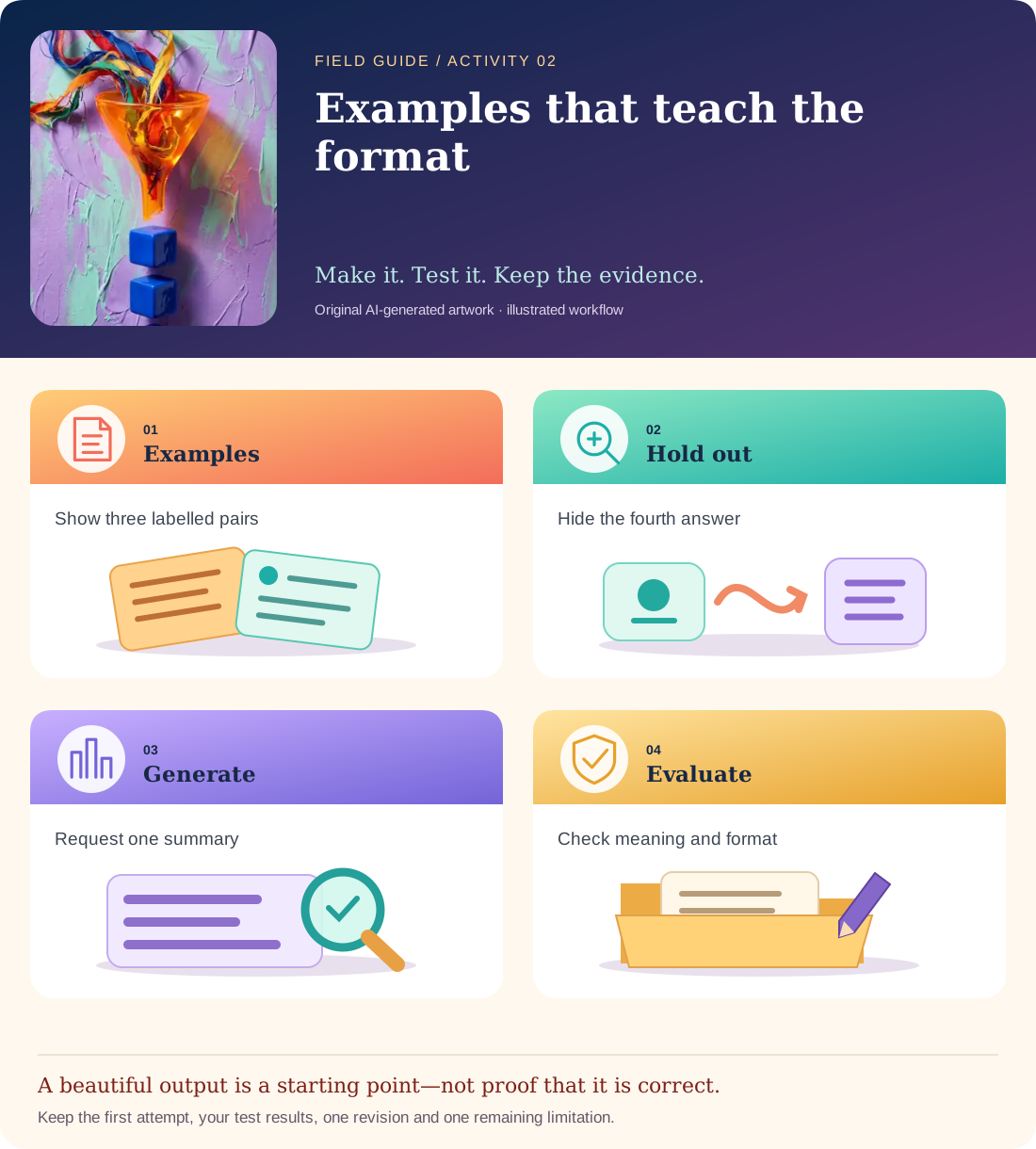
Conceptual illustration, not a provider screenshot. Artwork is AI-generated; instructional labels are authored text.
Start with fictional input
Email 1: My parcel was due Monday. It is Wednesday and nothing arrived. → Summary: Delivery — parcel two days late.
Email 2: The receipt shows $18 but my card was charged $23. → Summary: Billing — charged $5 above receipt.
Email 3: The lid cracked on first use. → Summary: Product — lid cracked on first use.
Held-out email: I paid for two notebooks; the parcel contained one.
Copy and adapt this prompt
Learn the summary format from the three labelled examples. Summarize only the held-out email as “Summary: Category — one factual issue.” Use Delivery, Billing, Product or Needs review. Do not invent a cause, remedy or refund.
[Paste examples and held-out email.]
Worked reference—not proof of correctness
Acceptable held-out result: Summary: Delivery — one of two paid notebooks missing. “Billing — customer charged twice” is not supported: the complaint concerns a missing item, not two payments.
Five practical steps
Prepare the demonstrations
Copy the first three input/output pairs and name the allowed categories.
Hold one case back
Keep the notebook email out of the demonstrations; write your own expected summary before querying.
Run the few-shot prompt
Compare its output with your reference on category, issue, prefix and invented facts.
Try ambiguity
Replace the held-out email with “It happened again.” A safe result asks for review rather than inventing a specific issue.
Refine one example
If the notebook case fails, add a missing-item example and test a new held-out email, not the same one only.
Test your result
- The held-out summary captures one missing notebook without claiming a duplicate payment.
- The ambiguous email receives Needs review or a clarification, not invented details.
- The exact prefix, category separator and one-issue rule remain consistent across three new tests.
Mistakes to watch for
- Evaluating only on examples already shown to the model.
- Calling formatting consistency evidence of factual accuracy.
Offline / no-key route
Classify the four emails on paper, then ask a partner to infer your formatting rule from the first three.
Reflect
What changed when you improved the examples: the category decision, the formatting, or both?
Keep your notes, tests and self-review →Self-reported practice is not independent assessment or a qualification. Browse all 50 guides · Choose a tool