
Audit framing without declaring perfect neutrality
Separate verifiable claims, opinions and rhetorical framing.
35 minutes estimated—not learner-validated. Original learning materials are free; optional external AI access may require an account, credits or payment.
Start the editable activity →No account needed to begin. Explicit account saving and editable offline export are available in the workspace.
New here? Try the three-activity starter ↗
Why this matters
Removing adjectives does not produce an unbiased account: selection and omission can still shape a story. Preserve who said what, the scope of numbers and uncertainty. This exercise produces a transparent evidence ledger and a cautious rewrite, not an authoritative neutral version of reality.
Before you start
Materials are free. External tools may require an adult account, credits, regional eligibility or a paid plan. Check current terms before using them. Do not paste passwords, API keys, private messages or other people’s personal data. No model runs locally or downloads automatically on this platform.
Your illustrated field guide
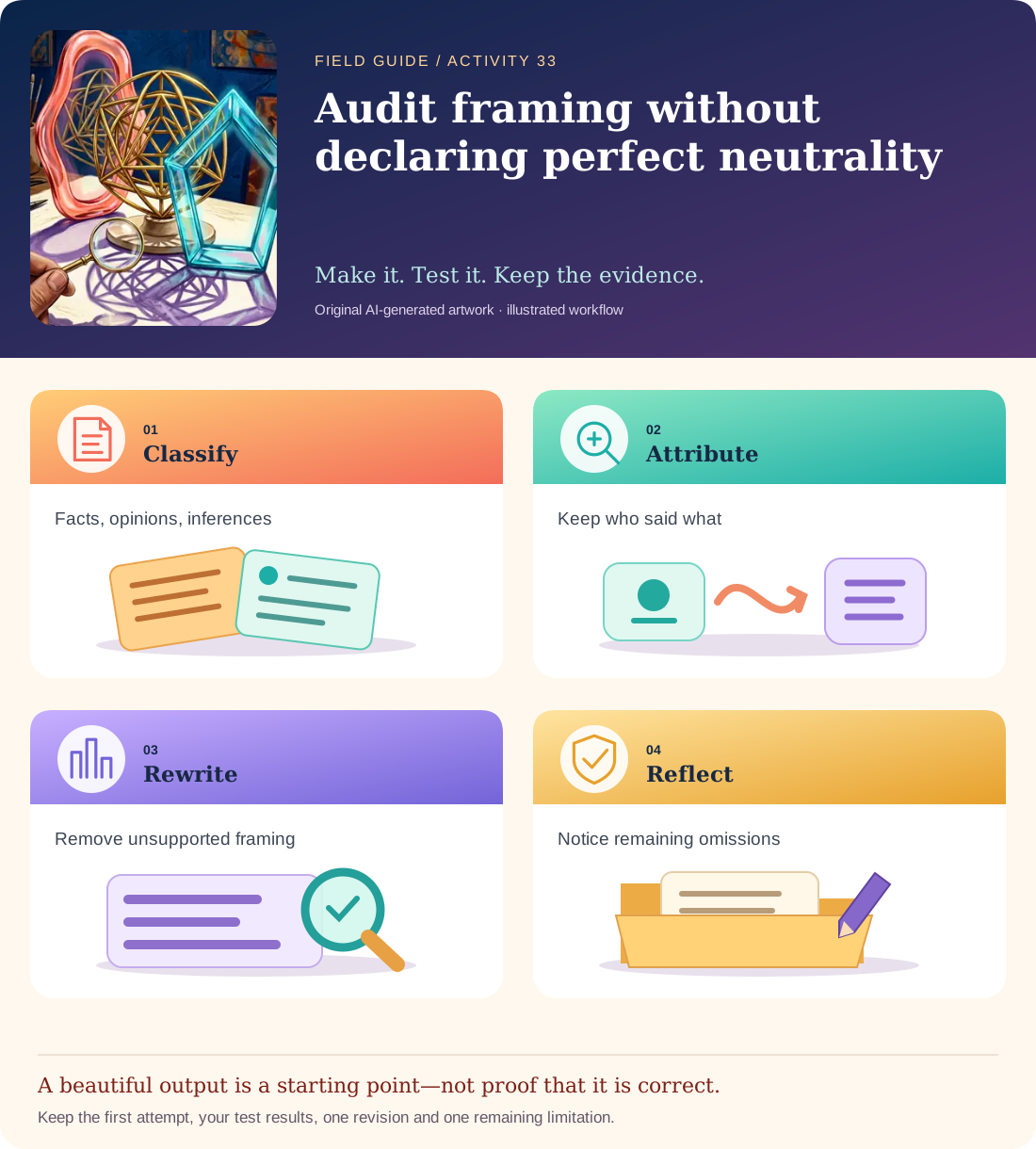
Conceptual illustration, not a provider screenshot. Artwork is AI-generated; instructional labels are authored text.
Start with fictional input
Fictional opinion: “The disastrous queue system wasted everyone’s day. The office says 80 visitors attended on Tuesday and the median wait was 35 minutes. One visitor called the experience unbearable. Clearly the entire service is beyond repair.”
Copy and adapt this prompt
Split the text into checkable claims, attributed opinions and unsupported inferences. Preserve attribution. Then write a restrained summary using only supported statements and indicate what is missing. Do not turn “the office says” into independent verification or “median” into “everyone.”
Worked reference—not proof of correctness
Checkable attributed claim: office reports 80 Tuesday visitors and a 35-minute median wait. Attributed opinion: one visitor found it unbearable. Unsupported inference: the whole service is beyond repair. Needed: measurement method, comparison period and broader visitor evidence.
Five practical steps
Mark claim types
Use three colours for factual assertions, attributed opinions and rhetorical conclusions.
Request the ledger
Require source wording and explicit attribution for each retained item.
Rewrite cautiously
Keep the reported numbers and opinion source, removing the sweeping conclusion.
Check selection bias
List whose experience and which time periods are absent.
Compare versions
Explain how omission or source choice can still frame the rewritten paragraph.
Test your result
- The office’s claim stays attributed and the median is not generalized to all visitors.
- One person’s opinion is not presented as a population finding.
- The final note names missing context and avoids claiming perfect neutrality.
Mistakes to watch for
- Assuming adjective removal eliminates bias.
- Dropping attribution because the remaining sentence sounds cleaner.
Offline / no-key route
Annotate and rewrite the supplied opinion manually, keeping the same evidence categories.
Reflect
Which choice in your own rewrite still influenced the reader’s interpretation?
Keep your notes, tests and self-review →Self-reported practice is not independent assessment or a qualification. Browse all 50 guides · Choose a tool