
Build an honest fruit-classifier test
Design balanced training and held-out sets and identify background leakage.
60 minutes estimated—not learner-validated. Original learning materials are free; optional external AI access may require an account, credits or payment.
Start the editable activity →No account needed to begin. Explicit account saving and editable offline export are available in the workspace.
New here? Try the three-activity starter ↗
Why this matters
A classifier may learn the plate or background instead of the fruit. Use your own apple and orange photographs with varied backgrounds. A cloud vision prompt is not custom training; only use that label if an actual supported hosted training service was run. No retired desktop tool or local model download is required.
Before you start
Materials are free. External tools may require an adult account, credits, regional eligibility or a paid plan. Check current terms before using them. Do not paste passwords, API keys, private messages or other people’s personal data. No model runs locally or downloads automatically on this platform.
Your illustrated field guide
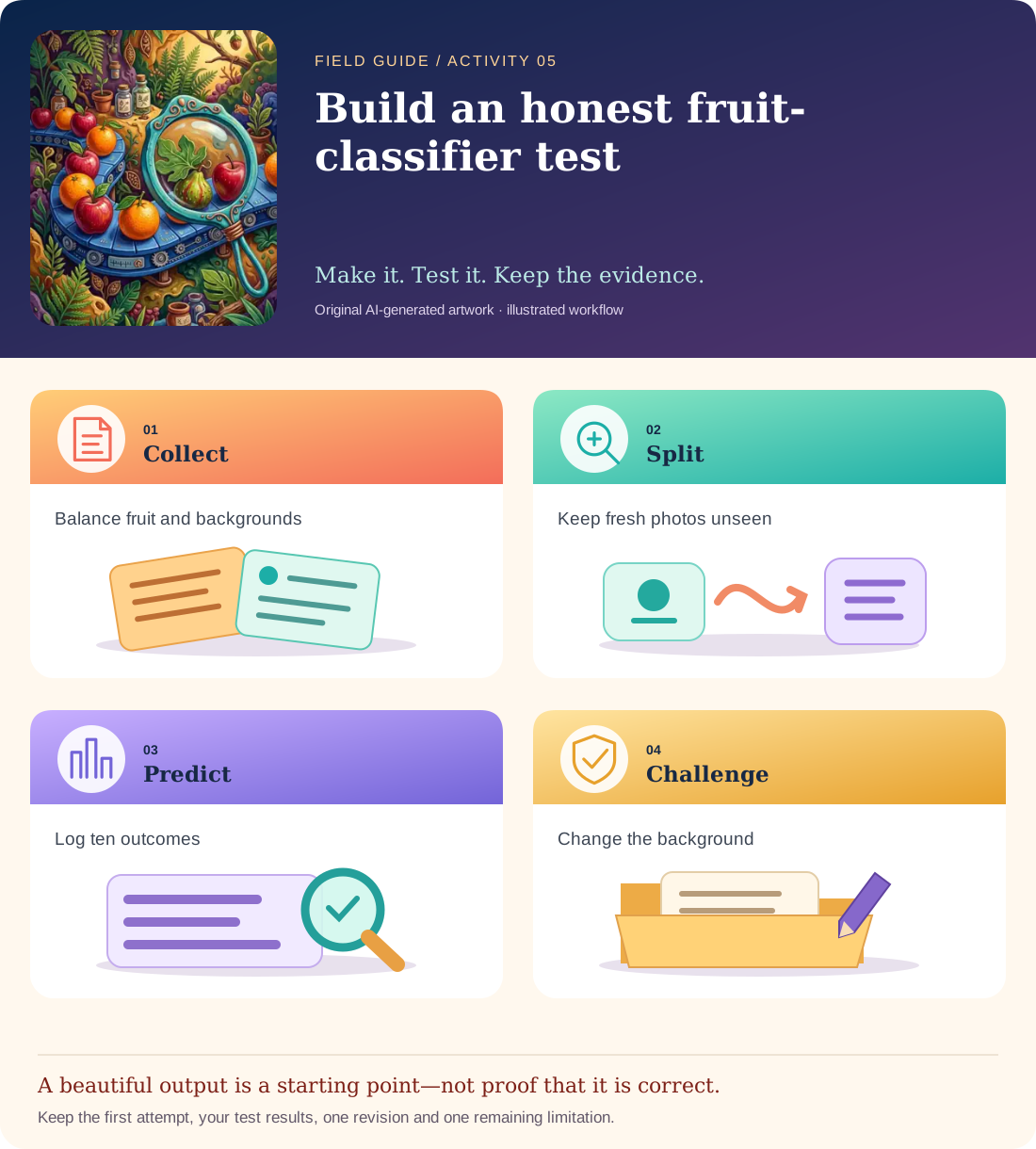
Conceptual illustration, not a provider screenshot. Artwork is AI-generated; instructional labels are authored text.
Start with fictional input
Dataset plan: 20 apple images and 20 orange images for training, plus 5 fresh images of each fruit for a held-out test. Vary background, distance and lighting in both labels. Keep all photos from one burst on the same side of the split.
Copy and adapt this prompt
For the classification-only route: Label this image Apple, Orange or Unclear based on the fruit, not background colour. Give one visible reason and do not guess when the object is hidden. I will score the result against a separate label sheet.
Worked reference—not proof of correctness
Reference score example: apples 4/5 correct, oranges 3/5 correct, total 7/10 = 70% on this tiny test only. If all orange images use a blue plate, a blue empty plate is a useful leakage test—not proof the model understands oranges.
Five practical steps
Plan before uploading
Write the two labels, unclear rule and ten held-out filenames before any model run.
Capture varied images
Use original object photos; do not reuse nearly identical burst frames across training and testing.
Run the chosen route
Use a supported hosted trainer if available, or pretrained cloud classification; state which happened and check charges first.
Score held-out cases
Make a two-by-two actual/predicted table and list unclear cases separately. Never discard failures to improve the score.
Break the shortcut
Try a different plate and an empty familiar background. Explain whether the results suggest leakage.
Test your result
- Ten unseen test files and their outcomes are retained without overlap with training examples.
- Correct predictions divided by all ten test cases matches the reported percentage.
- The report distinguishes pretrained classification from custom training and mentions the small sample.
Mistakes to watch for
- Reporting training-set accuracy as future performance.
- Letting background or near-duplicate photos reveal the label.
Offline / no-key route
Sort filename cards into balanced train/test sets and calculate scores from the worked example. Report a test-design exercise, not a trained model.
Reflect
Would the score mean the same thing if every apple used a red plate?
Keep your notes, tests and self-review →Self-reported practice is not independent assessment or a qualification. Browse all 50 guides · Choose a tool