
Run a fair mock interview panel
Practise evidence-based answers without treating a simulation as a hiring prediction.
35 minutes estimated—not learner-validated. Original learning materials are free; optional external AI access may require an account, credits or payment.
Start the editable activity →No account needed to begin. Explicit account saving and editable offline export are available in the workspace.
New here? Try the three-activity starter ↗
Why this matters
A simulated panel is a rehearsal partner, not a real employer or assessment. Use job-relevant questions and avoid protected traits, stereotypes or personality diagnosis. Ask one question at a time and score answers by concrete evidence, relevance and limits. Use a fictional role and truthful experience.
Before you start
Materials are free. External tools may require an adult account, credits, regional eligibility or a paid plan. Check current terms before using them. Do not paste passwords, API keys, private messages or other people’s personal data. No model runs locally or downloads automatically on this platform.
Your illustrated field guide
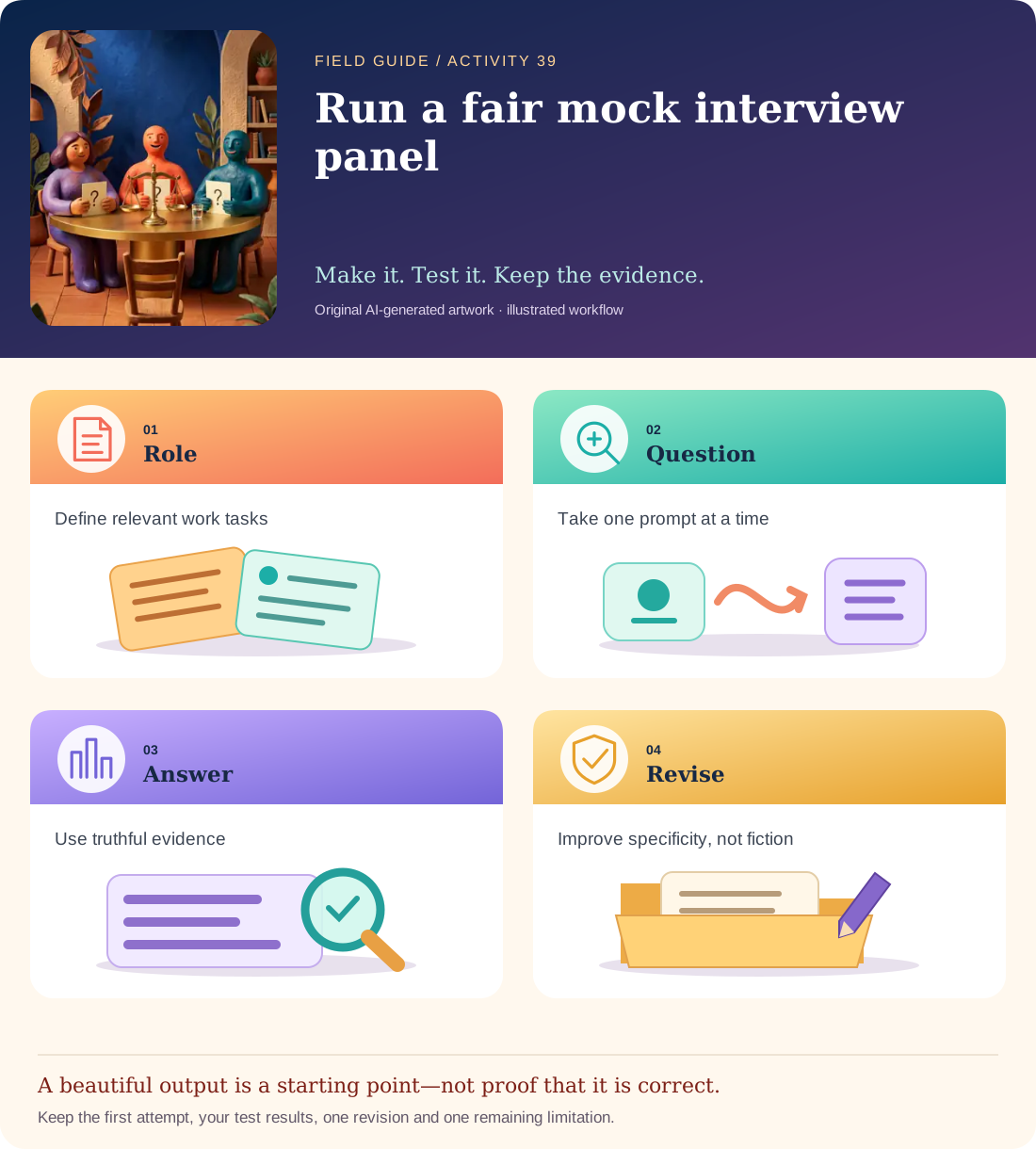
Conceptual illustration, not a provider screenshot. Artwork is AI-generated; instructional labels are authored text.
Start with fictional input
Role: project support coordinator. Tasks: track actions, escalate blockers, communicate status and keep a simple budget log. Four desired questions: prioritization, a missed deadline, unclear ownership and a reporting mistake. No real employer is represented.
Copy and adapt this prompt
Act as a clearly fictional practice panel: an execution reviewer and a collaboration reviewer. Alternate four job-relevant questions, one at a time, waiting for my answer. Give concise feedback on evidence, relevance and missing detail. Do not predict hiring success, ask protected-personal questions or invent my experience.
Worked reference—not proof of correctness
A useful answer describes the situation, the action you actually took and a measured or observable result. If no result is known, say so. “This answer guarantees you the role” is unacceptable simulated feedback.
Five practical steps
Define the role
Use the task list and choose a truthful example you are comfortable sharing.
Start one question
Check that the model waits instead of writing your answers for you.
Answer with evidence
Separate what happened, what you did and what you can actually support.
Review the feedback
Reject invented strengths, demographic judgments or predictions about a real hiring process.
Revise one answer
Keep the first and revised answer, and explain the evidence you added or uncertainty you preserved.
Test your result
- Four questions are job-relevant and asked one at a time.
- Feedback concerns observable answer quality, not protected traits or hiring predictions.
- The revised answer contains no invented experience or result.
Mistakes to watch for
- Memorizing a fabricated success story.
- Treating an AI panel’s approval as a real qualification.
Offline / no-key route
Have a partner read the four questions one at a time, or record your own answers and use the evidence checklist.
Reflect
Which revision made the answer more credible without making it more impressive?
Keep your notes, tests and self-review →Self-reported practice is not independent assessment or a qualification. Browse all 50 guides · Choose a tool