
Translate jargon without changing the claim
Make a technical statement understandable without inventing business impact.
35 minutes estimated—not learner-validated. Original learning materials are free; optional external AI access may require an account, credits or payment.
Start the editable activity →No account needed to begin. Explicit account saving and editable offline export are available in the workspace.
New here? Try the three-activity starter ↗
Why this matters
Plain language should preserve uncertainty, conditions and numerical meaning. A model may replace jargon with impressive but unsupported savings or risk claims. Use a short fictional source and demand a parallel evidence ledger so the reader can see what was simplified and what remains unknown.
Before you start
Materials are free. External tools may require an adult account, credits, regional eligibility or a paid plan. Check current terms before using them. Do not paste passwords, API keys, private messages or other people’s personal data. No model runs locally or downloads automatically on this platform.
Your illustrated field guide
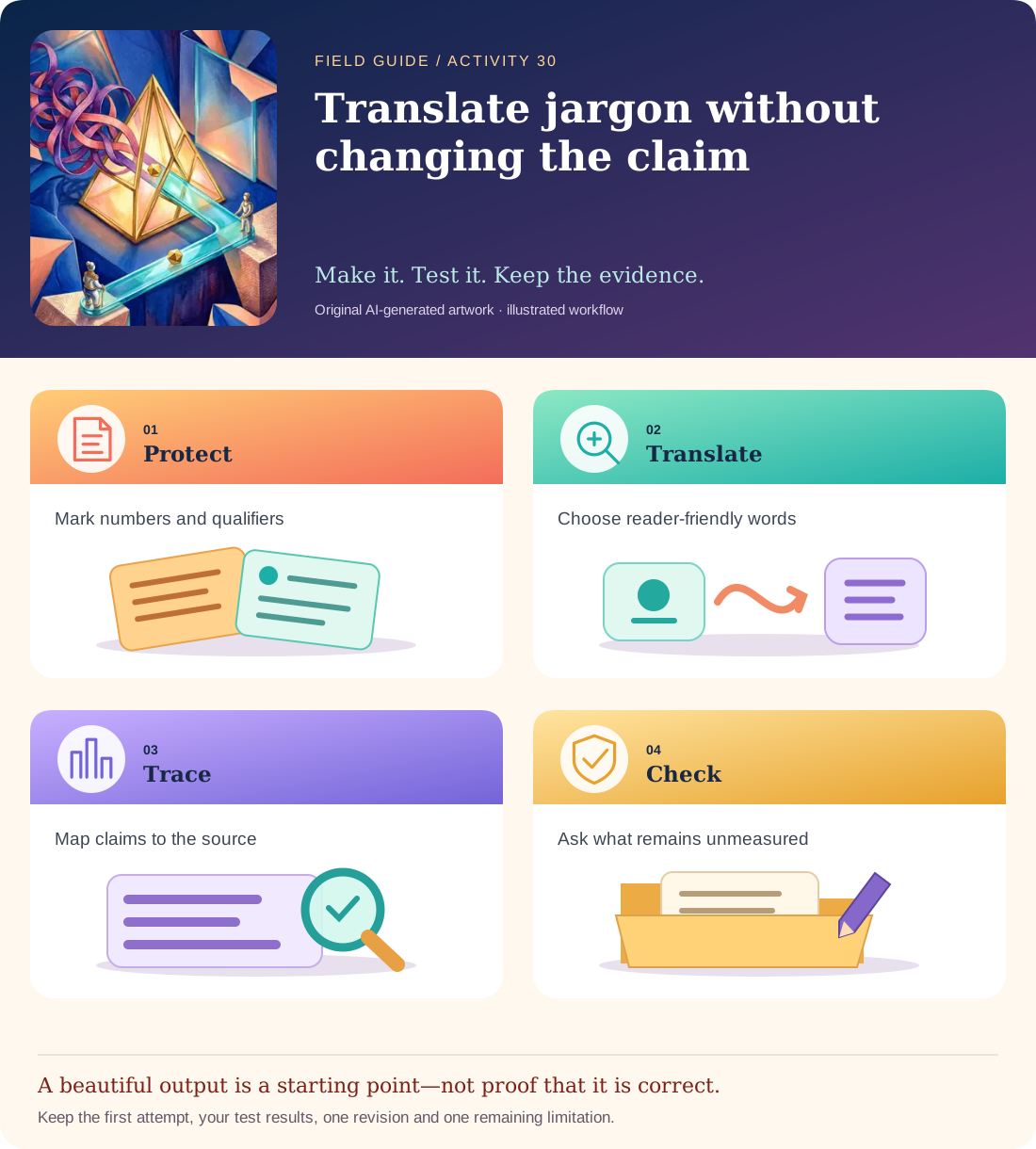
Conceptual illustration, not a provider screenshot. Artwork is AI-generated; instructional labels are authored text.
Start with fictional input
Source: “The prototype caches repeated requests for five minutes. In a 100-request test, 60 were served from cache. The test did not measure financial savings or peak-load behaviour.”
Copy and adapt this prompt
Rewrite the source for a non-technical operations reader. Preserve the five-minute window, the 60/100 test result and the unmeasured limits. Then provide a source-to-rewrite mapping. Do not convert cache hits into a claimed 60% cost reduction or a performance guarantee.
Worked reference—not proof of correctness
Acceptable: “For five minutes, the prototype can reuse some recent answers. In one small test it reused stored results for 60 of 100 requests. We have not tested cost savings or heavy traffic.” A 60% savings claim is unsupported.
Five practical steps
Mark protected meaning
Underline numbers, qualifiers and limitations in the source.
Generate the rewrite
Specify a reader and a shorter vocabulary, not a more persuasive sales message.
Build a mapping
Trace each rewritten claim to an exact source sentence.
Challenge an overclaim
Ask whether “60% cheaper” follows. Record why the missing cost measurements prevent that conclusion.
User-test comprehension
Ask a reader to explain what was measured and what was not.
Test your result
- All source numbers and limitations survive the rewrite.
- Cache-hit rate is not misrepresented as cost saving or guaranteed speed.
- A reader can distinguish the measured result from the untested business effect.
Mistakes to watch for
- Replacing technical jargon with invented business metrics.
- Deleting uncertainty because it makes the sentence shorter.
Offline / no-key route
Write a plain-language version yourself and highlight each source-to-rewrite link.
Reflect
Which qualifier would most change a decision if it disappeared?
Keep your notes, tests and self-review →Self-reported practice is not independent assessment or a qualification. Browse all 50 guides · Choose a tool