
From book notes to validated JSON
Distinguish valid JSON syntax, a data shape and a formal JSON Schema.
40 minutes estimated—not learner-validated. Original learning materials are free; optional external AI access may require an account, credits or payment.
Start the editable activity →No account needed to begin. Explicit account saving and editable offline export are available in the workspace.
New here? Try the three-activity starter ↗
Why this matters
Valid JSON can still contain wrong values or inconsistent records. First parse the text, then check the agreed keys and types, then compare facts with the source. This exercise converts records and describes a shape; a formal JSON Schema is a separate optional extension, not something every JSON array automatically contains.
Before you start
Materials are free. External tools may require an adult account, credits, regional eligibility or a paid plan. Check current terms before using them. Do not paste passwords, API keys, private messages or other people’s personal data. No model runs locally or downloads automatically on this platform.
Your illustrated field guide
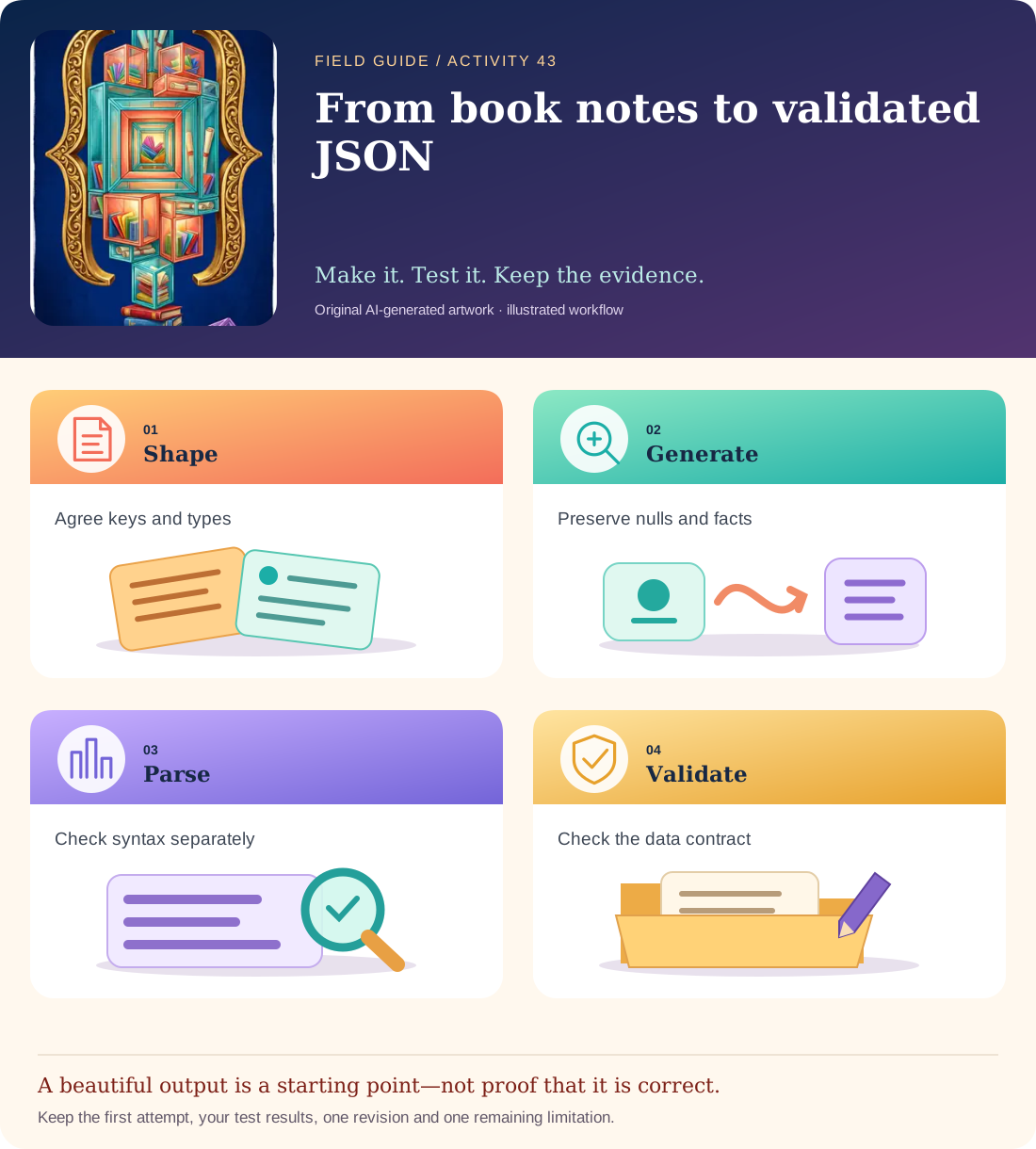
Conceptual illustration, not a provider screenshot. Artwork is AI-generated; instructional labels are authored text.
Start with fictional input
Fictional books: Paper Signals — A. Dube — 2021 — rating 4; Quiet Circuits — T. Moyo — 2023 — rating 5; Small Useful Things — N. Rao — year unknown — rating 3. Ratings are integers from 1 to 5. No additional books or authors are supplied.
Copy and adapt this prompt
Convert these three records to a JSON array using only lowercase keys: title, author, year, rating. Use an integer year or null when unknown; rating must be an integer from 1 to 5. Return JSON only, without comments, code fences, trailing commas or invented facts. Then, in a separate response if requested, describe the field rules.
Worked reference—not proof of correctness
One record: {"title":"Small Useful Things","author":"N. Rao","year":null,"rating":3}. A year of "unknown" is the wrong type for this contract, and a fabricated year such as 2020 is a factual error even if parsing succeeds.Five practical steps
Define the shape
Write exact keys, types, null policy and rating range before generating.
Request the array
Use the fixture and preserve missing years rather than filling them.
Parse the output
Use the activity checker; remove Markdown fences only if you understand they are wrappers, not JSON.
Validate the contract
Check array length, exact key set, types, null and rating range independently of parsing.
Check facts and break it
Compare titles/authors with the fixture, then try rating 9 or a trailing comma and note which check catches it.
Test your result
- JSON parsing succeeds and there are exactly three records with the agreed lowercase keys.
- Unknown year is null; ratings satisfy the integer 1–5 rule.
- Every title/author/value matches the fixture; syntax success is not mistaken for factual validity.
Mistakes to watch for
- Calling any valid JSON array a JSON Schema.
- Filling missing data to make the output look complete.
Offline / no-key route
Write the three structured records as a table and apply the same key/type/fact checklist.
Reflect
Which error can pass a JSON parser but still violate your requirements?
Keep your notes, tests and self-review →Self-reported practice is not independent assessment or a qualification. Browse all 50 guides · Choose a tool