
Make notes navigable with Markdown
Organize notes while preserving quotations, deadlines and unknowns.
35 minutes estimated—not learner-validated. Original learning materials are free; optional external AI access may require an account, credits or payment.
Start the editable activity →No account needed to begin. Explicit account saving and editable offline export are available in the workspace.
New here? Try the three-activity starter ↗
Why this matters
Formatting can help people find information, but a polished hierarchy can make invented conclusions look authoritative. Keep original text beside the formatted version and check that headings do not imply decisions that were never made. Markdown is plain text; different renderers support different features.
Before you start
Materials are free. External tools may require an adult account, credits, regional eligibility or a paid plan. Check current terms before using them. Do not paste passwords, API keys, private messages or other people’s personal data. No model runs locally or downloads automatically on this platform.
Your illustrated field guide
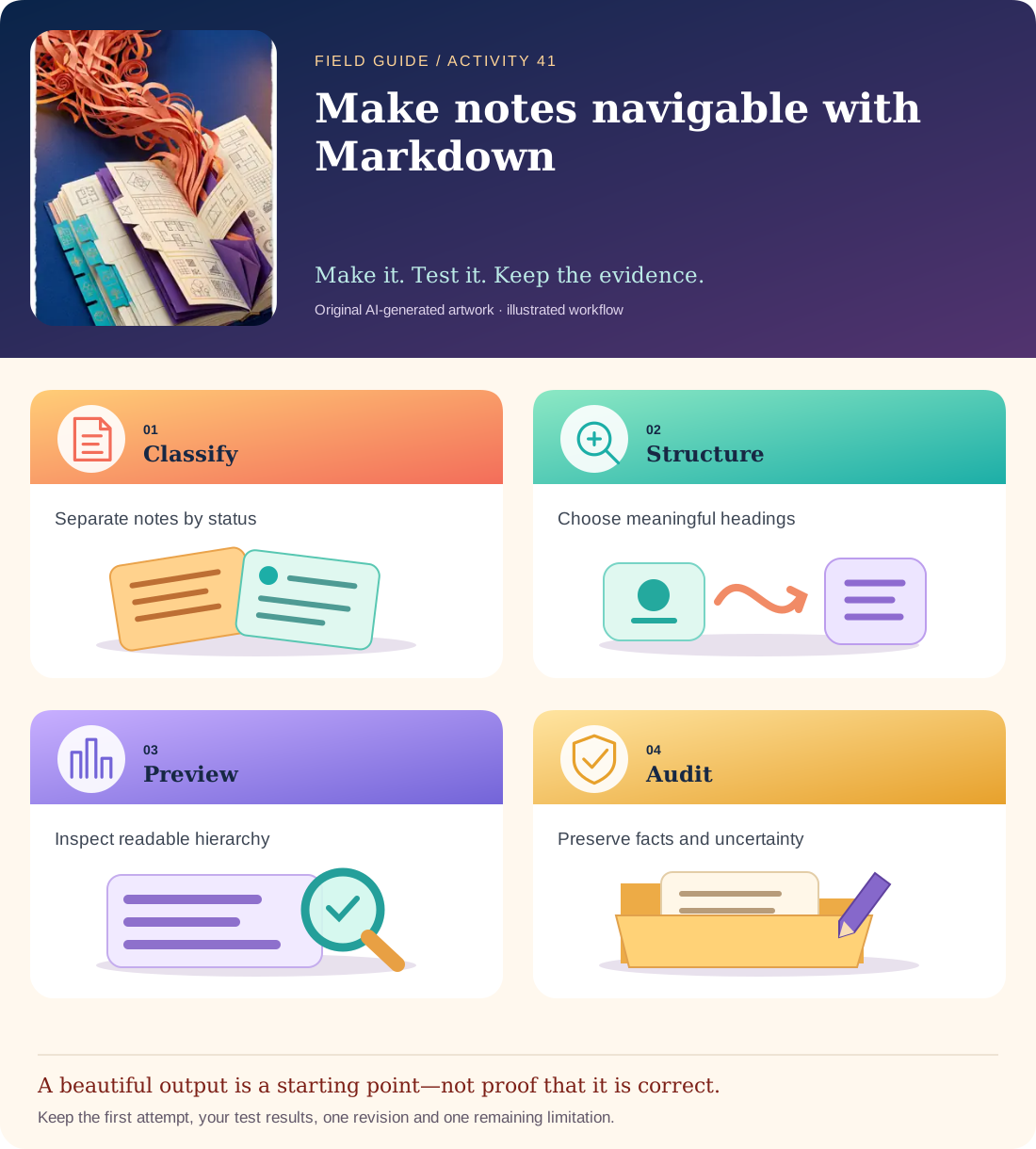
Conceptual illustration, not a provider screenshot. Artwork is AI-generated; instructional labels are authored text.
Start with fictional input
Raw notes: “Repair table idea. Nia said ‘Keep the first event small.’ Venue inquiry due Friday. Tools list not assigned. Budget proposal $80, not approved. Need insurance check. Next discussion Tuesday.”
Copy and adapt this prompt
Organize these notes in Markdown using one H1 title, H2 sections for Confirmed actions, Proposals and Open questions, a blockquote for the exact quotation, bold deadlines and a horizontal rule before next steps. Preserve the unassigned owner and unapproved budget. Do not invent decisions.
Worked reference—not proof of correctness
Expected structure: # Repair table planning; ## Confirmed actions → venue inquiry due **Friday**; ## Proposals → $80 budget, not approved; ## Open questions → tools owner and insurance check. The quotation must retain its wording and attribution.
Five practical steps
Mark the source states
Identify quote, commitment, proposal and unresolved question before formatting.
Generate plain Markdown
Keep the raw syntax so you can inspect #, >, ** and --- directly.
Preview safely
Use the activity’s text-only rendered preview; raw HTML is not required.
Audit the meaning
Compare all named dates, ownership and budget status with the raw notes.
Test portability
Open the Markdown as plain text and check that the structure is still understandable.
Test your result
- The quote is exact and the proposed budget remains unapproved.
- Heading levels are consistent and deadlines are emphasized without changing them.
- Unassigned actions remain unassigned; no formatting implies a false decision.
Mistakes to watch for
- Making a proposal look like an approved action by moving it under the wrong heading.
- Assuming every Markdown renderer handles tables or raw HTML identically.
Offline / no-key route
Write the Markdown by hand and compare the raw syntax with a paper outline.
Reflect
Which heading choice could most easily change how the notes are interpreted?
Keep your notes, tests and self-review →Self-reported practice is not independent assessment or a qualification. Browse all 50 guides · Choose a tool