
Build your own writing style profile
Extract reusable stylistic preferences without copying private or identifiable material.
35 minutes estimated—not learner-validated. Original learning materials are free; optional external AI access may require an account, credits or payment.
Start the editable activity →No account needed to begin. Explicit account saving and editable offline export are available in the workspace.
New here? Try the three-activity starter ↗
Why this matters
A style profile is a rough description, not a perfect clone of a person. Use your own writing or the original fictional samples here. Separate style from facts, and avoid including contact details, confidential situations or signatures in reusable profiles. Compare a new draft with a checklist rather than asking whether it “sounds exactly like me.”
Before you start
Materials are free. External tools may require an adult account, credits, regional eligibility or a paid plan. Check current terms before using them. Do not paste passwords, API keys, private messages or other people’s personal data. No model runs locally or downloads automatically on this platform.
Your illustrated field guide
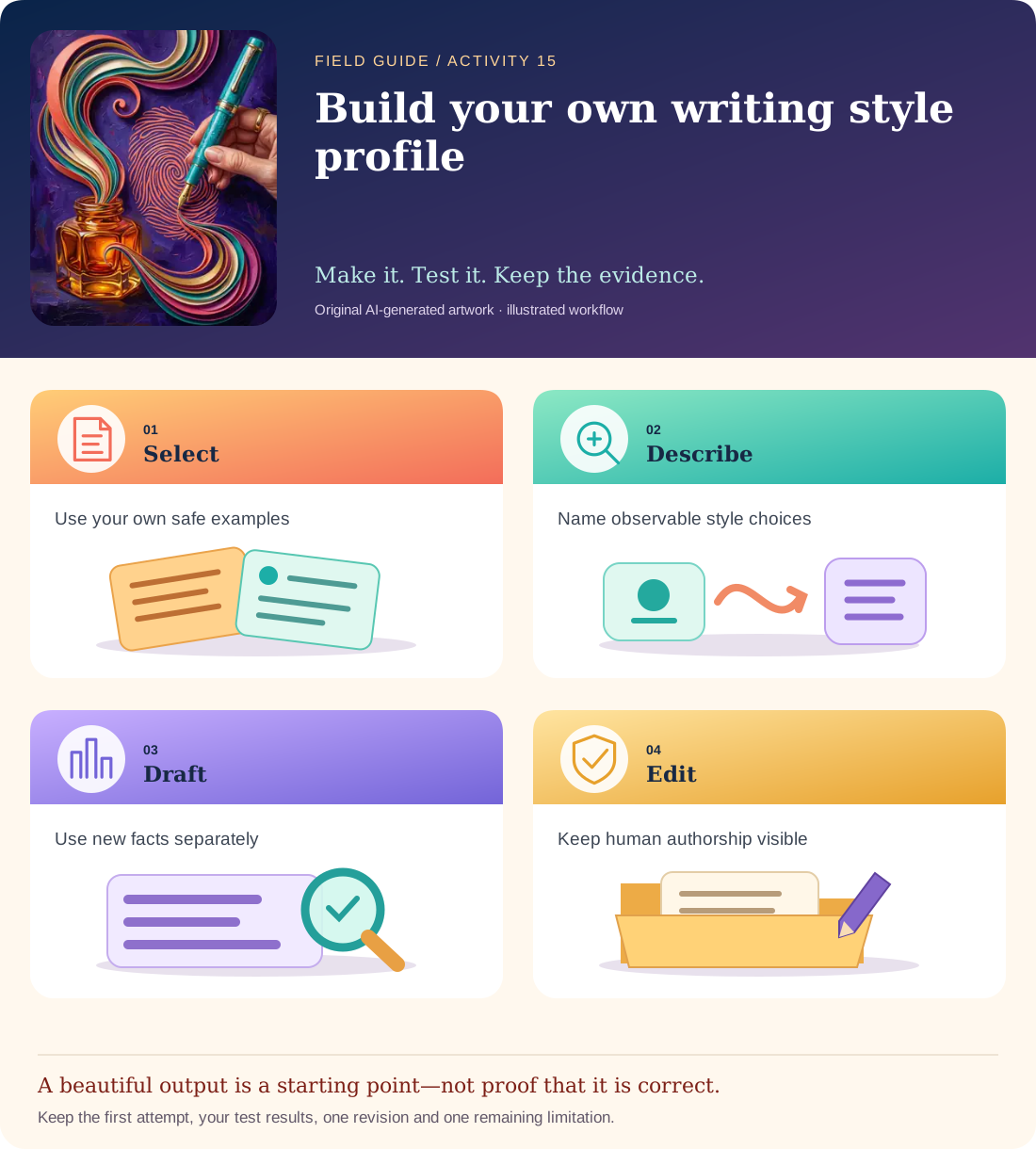
Conceptual illustration, not a provider screenshot. Artwork is AI-generated; instructional labels are authored text.
Start with fictional input
Samples: “Thanks for the quick update. I will check the list this afternoon. Please flag anything urgent.” “The first draft is ready. Two details still need review. Could we check them on Friday?” “I appreciate the help. The handover is clearer now. Next time, let us agree the owner earlier.”
Copy and adapt this prompt
Describe the visible style of these samples using sentence length, tone, vocabulary, punctuation and structure. Do not infer demographics or personality. Then draft an original thank-you note for a fictional venue host using: room access was helpful; cleanup finished on time; no promise of future bookings.
Worked reference—not proof of correctness
Useful profile: short direct sentences, polite but not flowery, explicit next actions, restrained punctuation. An acceptable note thanks the host for access and mentions timely cleanup. A promise to book every month violates the supplied facts.
Five practical steps
Select safe samples
Use only your own permissioned text or the fixture. Remove names, signatures and private facts.
Extract a profile
Ask for observable writing features; reject claims about personality or identity.
Draft on a new topic
Supply the new facts separately so style examples are not treated as current facts.
Score the draft
Check sentence length, directness, tone and absence of invented promises.
Make it yours
Edit one sentence manually and note what the AI profile missed.
Test your result
- The profile describes visible writing choices, not inferred personal traits.
- The new note includes only the three supplied facts and no future booking promise.
- A human edit and its reason are saved alongside the draft.
Mistakes to watch for
- Uploading private correspondence or cloning another person without permission.
- Treating repetitive wording as a perfect personal voice.
Offline / no-key route
Annotate the three samples and write the new note manually from the style checklist.
Reflect
Which part of your writing does a short style profile fail to capture?
Keep your notes, tests and self-review →Self-reported practice is not independent assessment or a qualification. Browse all 50 guides · Choose a tool