
Read a paper without overselling it
Separate research question, method, result and real-world applicability.
45 minutes estimated—not learner-validated. Original learning materials are free; optional external AI access may require an account, credits or payment.
Start the editable activity →No account needed to begin. Explicit account saving and editable offline export are available in the workspace.
New here? Try the three-activity starter ↗
Why this matters
A paper’s abstract is not enough to establish a practical business benefit. Check the population, sample, comparison, outcome and stated limitations. Use the original fictional abstract first; when trying an actual paper, access a legitimate copy and keep its title/version. AI summaries are reading aids, not peer review.
Before you start
Materials are free. External tools may require an adult account, credits, regional eligibility or a paid plan. Check current terms before using them. Do not paste passwords, API keys, private messages or other people’s personal data. No model runs locally or downloads automatically on this platform.
Your illustrated field guide
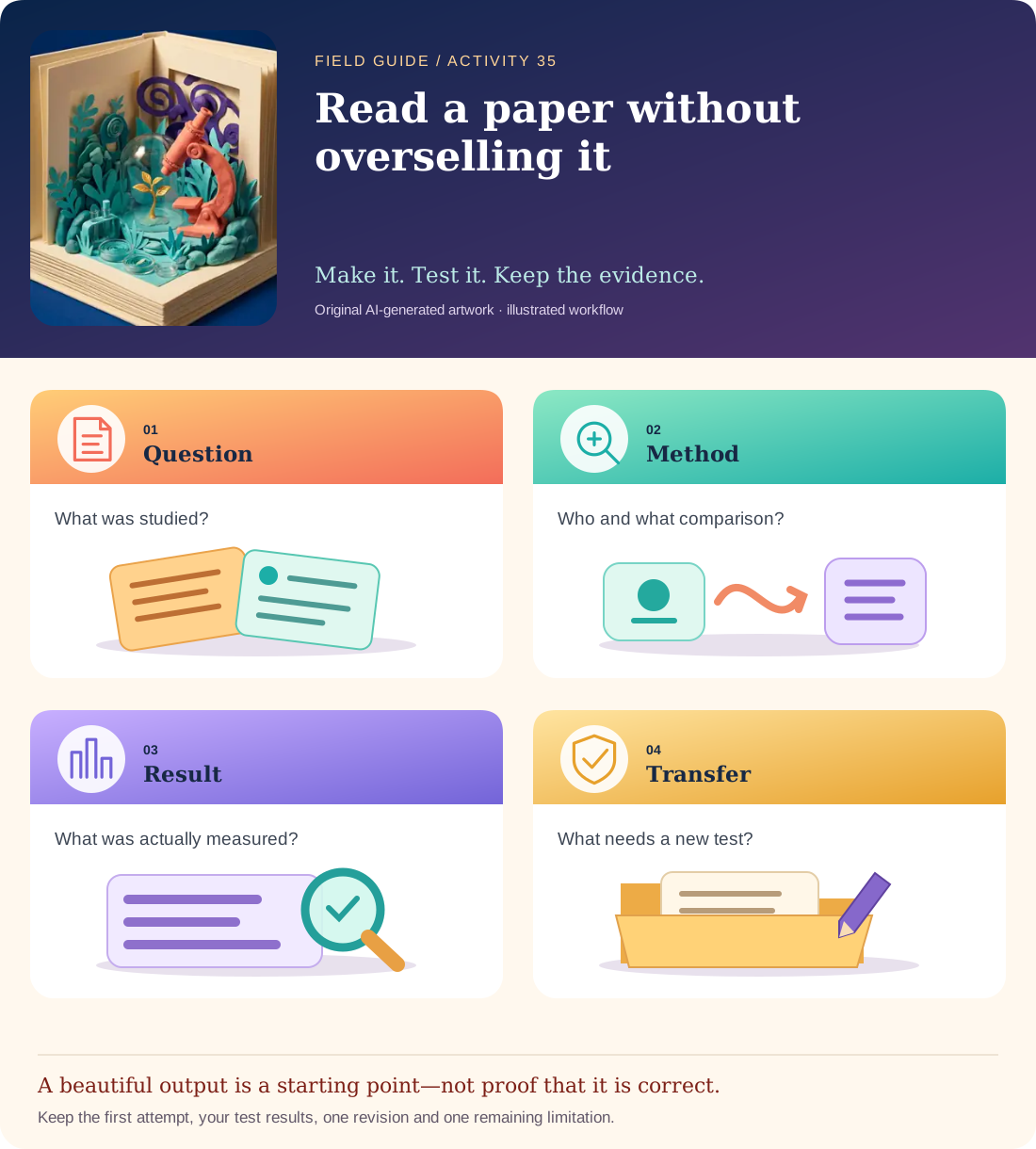
Conceptual illustration, not a provider screenshot. Artwork is AI-generated; instructional labels are authored text.
Start with fictional input
Fictional abstract: “Twenty volunteers were randomly assigned to checklist or no-checklist groups for a simulated packing task. Median omissions were 1 versus 3. The task lasted one afternoon. No long-term retention, business revenue or safety outcome was measured.”
Copy and adapt this prompt
Explain the question, sample, comparison, measured outcome and limitations in plain language. Separate the reported result from three possible follow-up applications, each labelled a hypothesis. Do not invent statistical significance, causal mechanisms, long-term effects or revenue gains.
Worked reference—not proof of correctness
Reported: lower median omissions in the checklist group in this small simulated task. Hypothesis: test a checklist in a different packing workflow. Unsupported: “checklists triple business productivity” or “the study proves permanent safety improvements.”
Five practical steps
Read the supplied abstract
Highlight population, comparison, outcome, duration and limitations.
Generate a structured summary
Ask for separate method, result and applicability sections.
Check each claim
Trace the summary to exact abstract words; mark missing statistics as missing.
Design a follow-up
Choose one setting and define a measurable outcome plus a risk/limitation.
Try a real paper optionally
Read methods and limitations, not just the generated summary, before proposing any application.
Test your result
- Sample size, simulated context and one-afternoon duration remain visible.
- No significance level, revenue result or long-term benefit is invented.
- Suggested applications are hypotheses with a proposed test, not established findings.
Mistakes to watch for
- Turning a small simulated result into a universal business claim.
- Accepting citations or statistics that do not occur in the paper.
Offline / no-key route
Complete the question/method/result/limit table by hand from the fictional abstract.
Reflect
Which business use would require the biggest leap beyond the reported evidence?
Keep your notes, tests and self-review →Self-reported practice is not independent assessment or a qualification. Browse all 50 guides · Choose a tool