
Build a prompt contract, not a mega-prompt
Combine role, context, constraints and format without burying the actual task.
35 minutes estimated—not learner-validated. Original learning materials are free; optional external AI access may require an account, credits or payment.
Start the editable activity →No account needed to begin. Explicit account saving and editable offline export are available in the workspace.
New here? Try the three-activity starter ↗
Why this matters
Long prompts are not automatically better. A useful contract includes a goal, available facts, restrictions and a checkable output shape. Conflicting requirements should trigger clarification rather than confident invention. This fictional recipe task is about instruction-following, not dietary or medical advice.
Before you start
Materials are free. External tools may require an adult account, credits, regional eligibility or a paid plan. Check current terms before using them. Do not paste passwords, API keys, private messages or other people’s personal data. No model runs locally or downloads automatically on this platform.
Your illustrated field guide
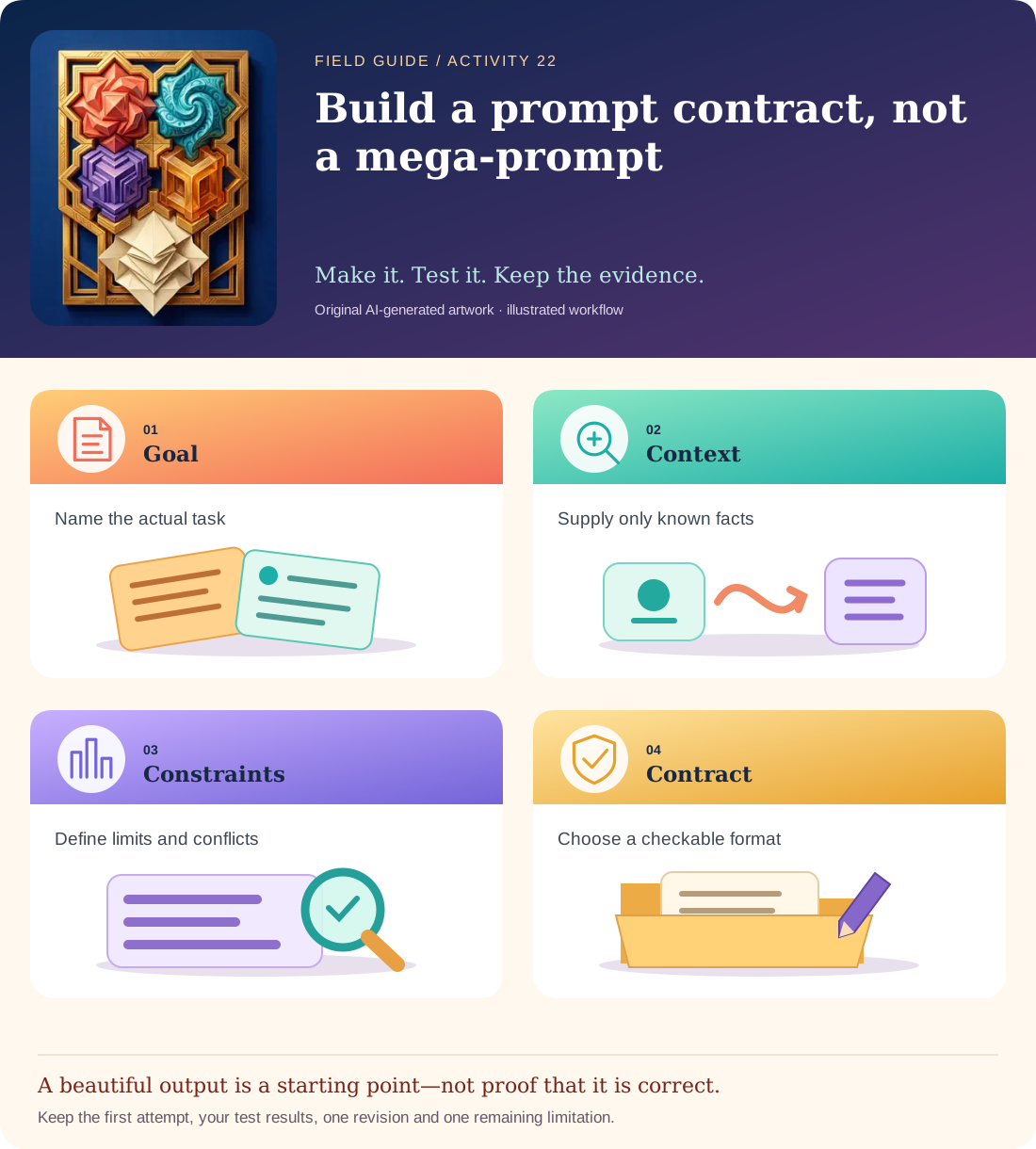
Conceptual illustration, not a provider screenshot. Artwork is AI-generated; instructional labels are authored text.
Start with fictional input
Available: 2 eggs, a handful of spinach, hot sauce, a bowl and a microwave-safe cooking container. No oil. Time budget 10 minutes. Appliance power and safe cooking guidance are not provided.
Copy and adapt this prompt
Role: practical recipe drafter. Context: use only the listed ingredients and equipment. Constraints: no oil; under 10 minutes if feasible; do not invent appliance settings or guarantee food safety. Format: ingredients, proposed steps, missing safety information, feasibility note. Ask for clarification when a safe procedure needs facts not supplied.
Worked reference—not proof of correctness
A good response notices that appliance details and safe cooking guidance are missing. It may draft a plan with review notes, but should not invent a universal microwave time or guarantee that a fixed duration makes eggs safe.
Five practical steps
Write the four parts
Separate role, context, constraints and output format into short labelled blocks.
Test the first prompt
Check every ingredient, equipment item and claimed cooking instruction.
Add a contradiction
Demand a five-course meal from the same two ingredients in two minutes. Observe whether it flags infeasibility.
Remove unnecessary text
Shorten the prompt while keeping all essential conditions; compare compliance.
Save a reusable template
Replace the recipe details with placeholders and include an explicit clarification rule.
Test your result
- The response adds no unlisted ingredients or equipment.
- Missing safety information is flagged rather than replaced with invented appliance settings.
- The contradictory case produces a feasibility warning or question, not a guaranteed result.
Mistakes to watch for
- Assuming more instructions always improve a prompt.
- Treating a generated recipe as food-safety advice.
Offline / no-key route
Use the four-part contract to ask a person for a plan, then score compliance with the same checklist.
Reflect
Which sentence was essential, and which extra detail merely made the prompt longer?
Keep your notes, tests and self-review →Self-reported practice is not independent assessment or a qualification. Browse all 50 guides · Choose a tool