
Check reasoning with an external answer
Compare answer-only and concise-explanation prompts against a known reference.
35 minutes estimated—not learner-validated. Original learning materials are free; optional external AI access may require an account, credits or payment.
Start the editable activity →No account needed to begin. Explicit account saving and editable offline export are available in the workspace.
New here? Try the three-activity starter ↗
Why this matters
A request for hidden chain-of-thought does not guarantee accuracy and is not needed. Ask instead for a short calculation, stated assumptions and a checkable result. A polished explanation can rationalize a wrong answer. Use a puzzle with an external solution and keep the input identical across conditions.
Before you start
Materials are free. External tools may require an adult account, credits, regional eligibility or a paid plan. Check current terms before using them. Do not paste passwords, API keys, private messages or other people’s personal data. No model runs locally or downloads automatically on this platform.
Your illustrated field guide
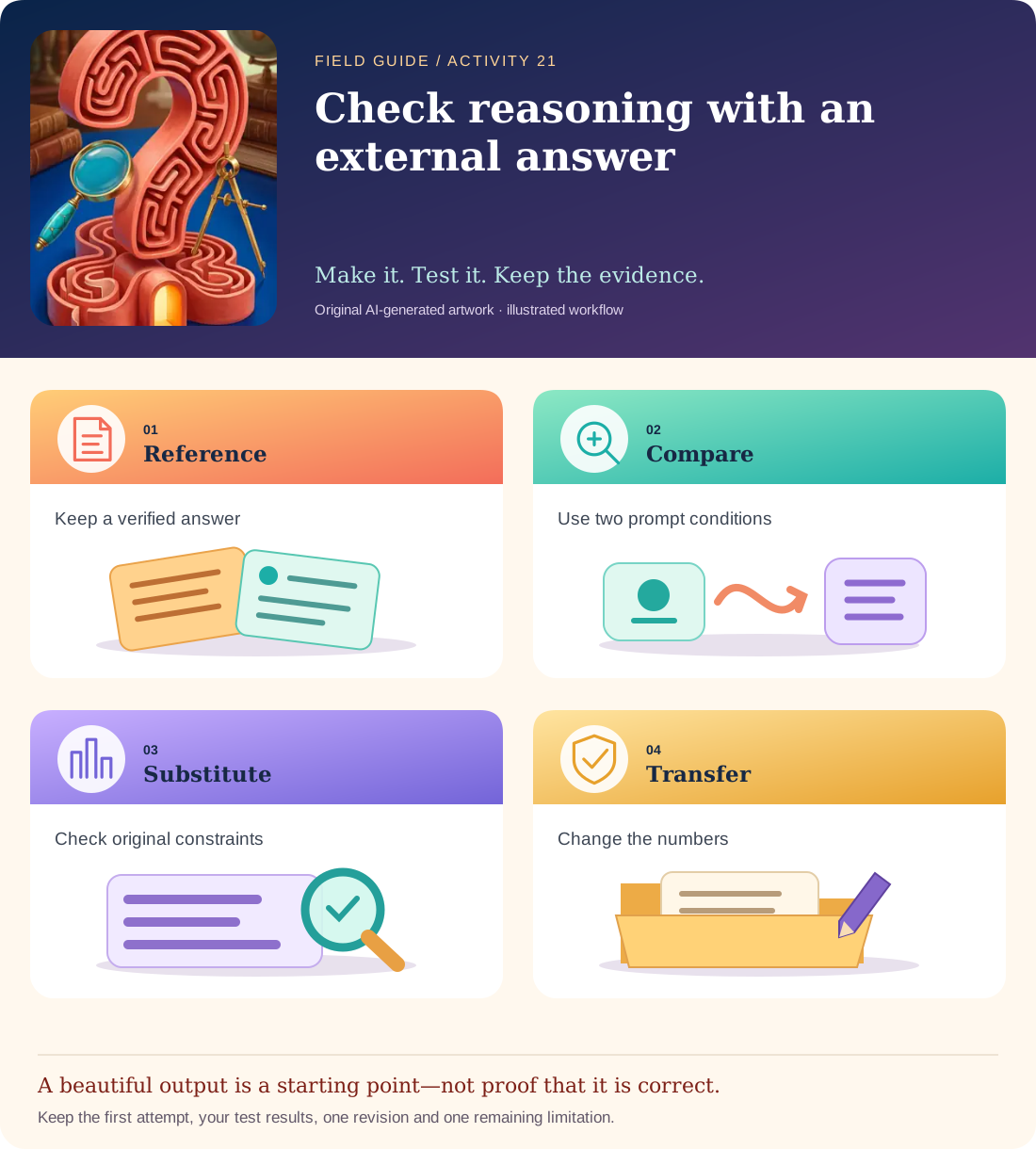
Conceptual illustration, not a provider screenshot. Artwork is AI-generated; instructional labels are authored text.
Start with fictional input
Puzzle: A notebook and a pen cost $1.10 together. The notebook costs $1.00 more than the pen. What does the pen cost? Reference: pen $0.05; notebook $1.05; total $1.10 and difference $1.00.
Copy and adapt this prompt
Solve the notebook-and-pen puzzle. State the answer, one short equation and a substitution check. Do not provide a private internal reasoning transcript. If you make an assumption, state it.
[Paste puzzle without the reference answer.]
Worked reference—not proof of correctness
Let pen cost p. Then notebook costs p + 1.00, so 2p + 1.00 = 1.10 and p = 0.05. A $0.10 pen would imply a $1.10 notebook, totaling $1.20, so the tempting answer fails.
Five practical steps
Record the reference
Hide the answer from the model and verify both total and difference yourself.
Run answer-only
Ask for just the price in a fresh hosted chat and save the unedited answer.
Run a concise-check version
Use the supplied prompt in a fresh context with the same puzzle.
Evaluate both externally
Substitute each answer into the original constraints; do not score by explanation length.
Transfer the test
Change the total to $1.30 with a $1.00 difference; the pen should be $0.15.
Test your result
- Both responses are checked against the total and difference, not judged on fluency.
- The report includes the $0.15 transfer case and its substitution check.
- You do not claim that longer explanations prevent errors or reveal hidden internal reasoning.
Mistakes to watch for
- Rewarding a long explanation even when its arithmetic is wrong.
- Leaking the reference answer into only one experimental condition.
Offline / no-key route
Solve the equation manually and compare the tempting wrong answer with the two original constraints.
Reflect
Did the explanation improve the result, or only make it sound more convincing?
Keep your notes, tests and self-review →Self-reported practice is not independent assessment or a qualification. Browse all 50 guides · Choose a tool