
Match a résumé without inventing experience
Find evidence gaps between a fictional résumé and a role description.
35 minutes estimated—not learner-validated. Original learning materials are free; optional external AI access may require an account, credits or payment.
Start the editable activity →No account needed to begin. Explicit account saving and editable offline export are available in the workspace.
New here? Try the three-activity starter ↗
Why this matters
Hiring systems vary; keyword matching is not a complete model of an applicant-tracking system. Optimizing wording must never fabricate skills, experience or results. This activity produces a gap ledger and an honest revision, not a promise of passing screening or getting hired.
Before you start
Materials are free. External tools may require an adult account, credits, regional eligibility or a paid plan. Check current terms before using them. Do not paste passwords, API keys, private messages or other people’s personal data. No model runs locally or downloads automatically on this platform.
Your illustrated field guide
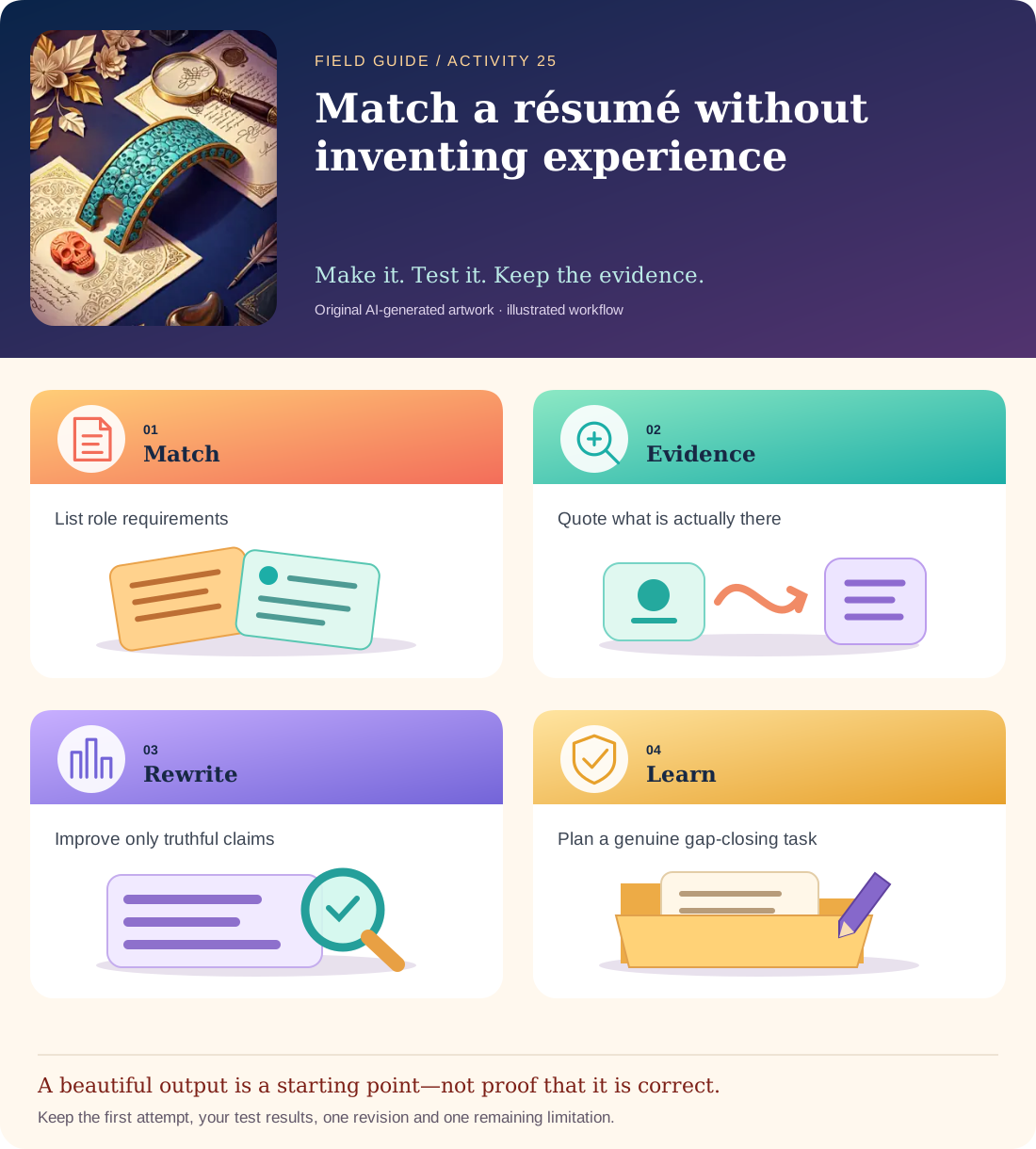
Conceptual illustration, not a provider screenshot. Artwork is AI-generated; instructional labels are authored text.
Start with fictional input
Role: support coordinator; requires ticket triage, clear customer writing, spreadsheet reporting, escalation and teamwork. Fictional résumé: “Answered community questions. Kept a weekly list of requests in a spreadsheet. Asked the coordinator to handle unresolved cases.” No paid employment, specific software certification or numerical results are supplied.
Copy and adapt this prompt
Map each role requirement to an exact résumé quote, or mark No evidence. Suggest clearer truthful wording only where evidence exists. List skills to learn separately. Do not add years, credentials, tool expertise or performance numbers. Do not predict an ATS score or hiring outcome.
Worked reference—not proof of correctness
Spreadsheet reporting has partial evidence in the weekly request list. Escalation has evidence in referring unresolved cases. A claim such as “Reduced ticket backlog by 40% using Zendesk” has no support and must not appear.
Five practical steps
Use fictional material
Keep personal identifiers and real employment documents out of the exercise.
Build the gap ledger
For each requirement, record exact evidence, partial evidence or no evidence.
Draft honest wording
Improve clarity for one supported bullet without inventing a metric or qualification.
Inspect a tempting invention
Ask whether a numerical result or tool name appeared despite being absent from the fixture.
Plan a real learning step
Choose one genuine gap and define a small project that could create evidence later.
Test your result
- Every revised claim traces to a fixture quote or is explicitly labelled a future learning goal.
- No unsupported numbers, software expertise or credentials appear.
- The result avoids promises about ATS ranking or hiring success.
Mistakes to watch for
- Keyword stuffing without evidence.
- Claiming all screening systems use the same scoring rules.
Offline / no-key route
Highlight evidence manually and rewrite one truthful bullet; score it against the same role requirements.
Reflect
Which missing keyword represented a real skill gap rather than a wording problem?
Keep your notes, tests and self-review →Self-reported practice is not independent assessment or a qualification. Browse all 50 guides · Choose a tool