
Reconcile two accounts without inventing consensus
Separate shared facts, real contradictions and unmentioned details.
35 minutes estimated—not learner-validated. Original learning materials are free; optional external AI access may require an account, credits or payment.
Start the editable activity →No account needed to begin. Explicit account saving and editable offline export are available in the workspace.
New here? Try the three-activity starter ↗
Why this matters
Two sources can differ because they cover different times or quote different people, not because one is necessarily false. Preserve attribution and compare like with like. Agreement is not proof of truth when sources may repeat the same origin. The fictional source pair includes a deliberate time distinction.
Before you start
Materials are free. External tools may require an adult account, credits, regional eligibility or a paid plan. Check current terms before using them. Do not paste passwords, API keys, private messages or other people’s personal data. No model runs locally or downloads automatically on this platform.
Your illustrated field guide
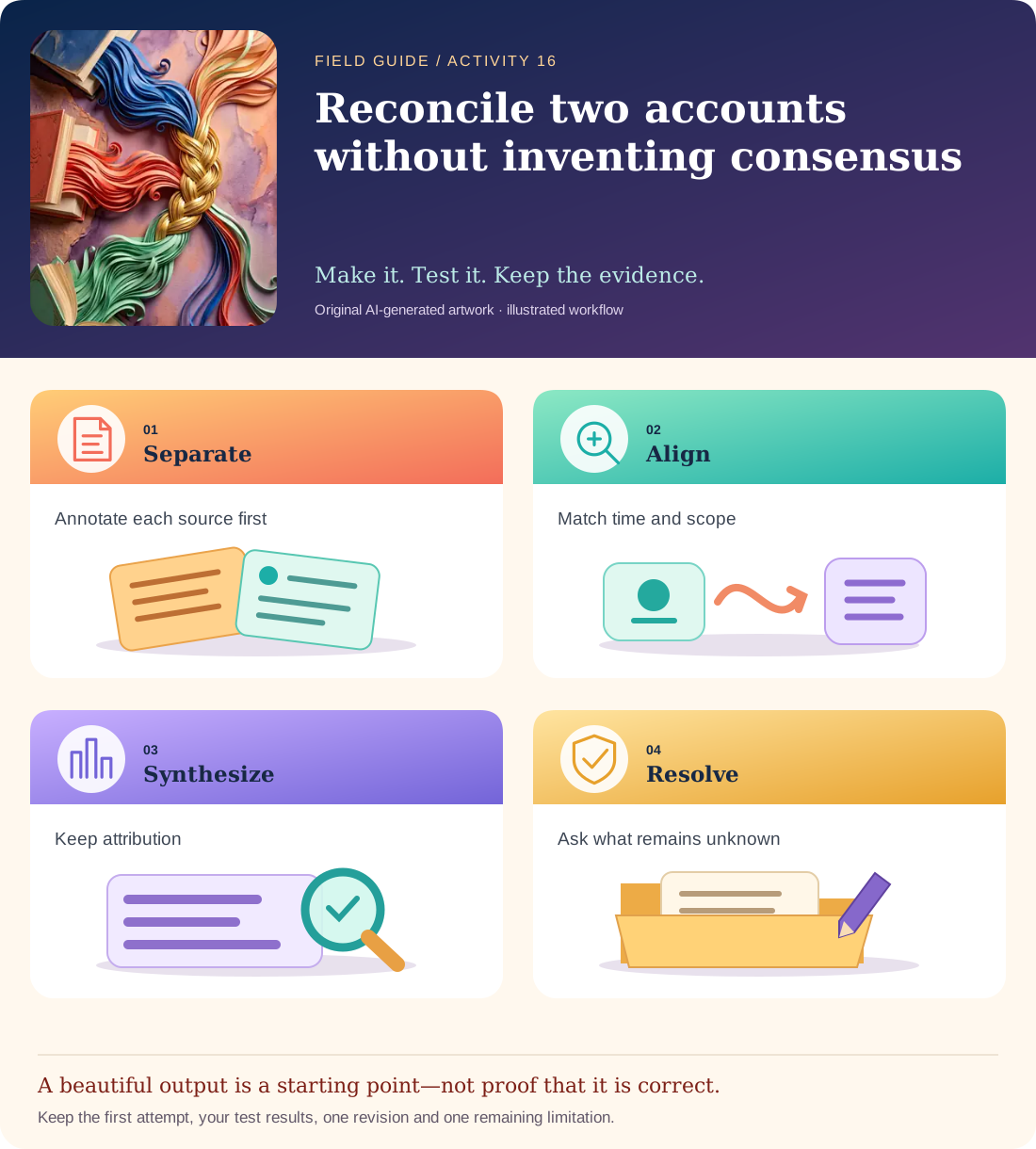
Conceptual illustration, not a provider screenshot. Artwork is AI-generated; instructional labels are authored text.
Start with fictional input
Source A, 09:00: “The repair event has 30 registrations. Organizers plan two tables. The venue is the East Hall.” Source B, 17:00: “Registrations reached 42 after lunch. Organizers confirmed East Hall and said a third table may be added.”
Copy and adapt this prompt
Create three sections: shared supported facts; differences with source/time attribution; unresolved questions. Distinguish a later update from a contradiction and a proposal from confirmation. Quote the relevant words. Do not average counts or invent a final decision.
Worked reference—not proof of correctness
Shared: East Hall. Updated count: 30 at 09:00 versus 42 by 17:00, not necessarily a conflict. Two planned tables versus a possible third is an unresolved plan, not confirmation that three exist.
Five practical steps
Annotate each source
Mark timestamp, confirmed facts, plans and tentative language independently.
Run the synthesis
Require source labels and quotes for every comparison.
Check alleged conflicts
Ask whether each difference concerns the same time, definition and scope.
Investigate dependence
Note that the texts may share an organizer as their original source; do not call them independent verification.
Draft a cautious update
State the most recent attributed facts and one question that needs confirmation.
Test your result
- The count change is identified as a time update rather than an automatic contradiction.
- The third table remains tentative.
- Every comparison has source/time attribution and no invented average or consensus.
Mistakes to watch for
- Treating omission as disagreement.
- Counting two articles that repeat one press release as two independent confirmations.
Offline / no-key route
Use a two-column evidence ledger and write the shared/different/unresolved sections by hand.
Reflect
Which apparent contradiction disappeared once you compared timestamps?
Keep your notes, tests and self-review →Self-reported practice is not independent assessment or a qualification. Browse all 50 guides · Choose a tool