
Stress-test a source-backed summary
Check whether a citation really supports the claim beside it.
45 minutes estimated—not learner-validated. Original learning materials are free; optional external AI access may require an account, credits or payment.
Start the editable activity →No account needed to begin. Explicit account saving and editable offline export are available in the workspace.
New here? Try the three-activity starter ↗
Why this matters
A URL can exist and still fail to support a statement. For current/local news, use an actual web-search-capable tool and verify every link yourself. Publication time is not always event time. Without live sources, use the fictional fixture and clearly label it; do not pretend a model searched.
Before you start
Materials are free. External tools may require an adult account, credits, regional eligibility or a paid plan. Check current terms before using them. Do not paste passwords, API keys, private messages or other people’s personal data. No model runs locally or downloads automatically on this platform.
Your illustrated field guide
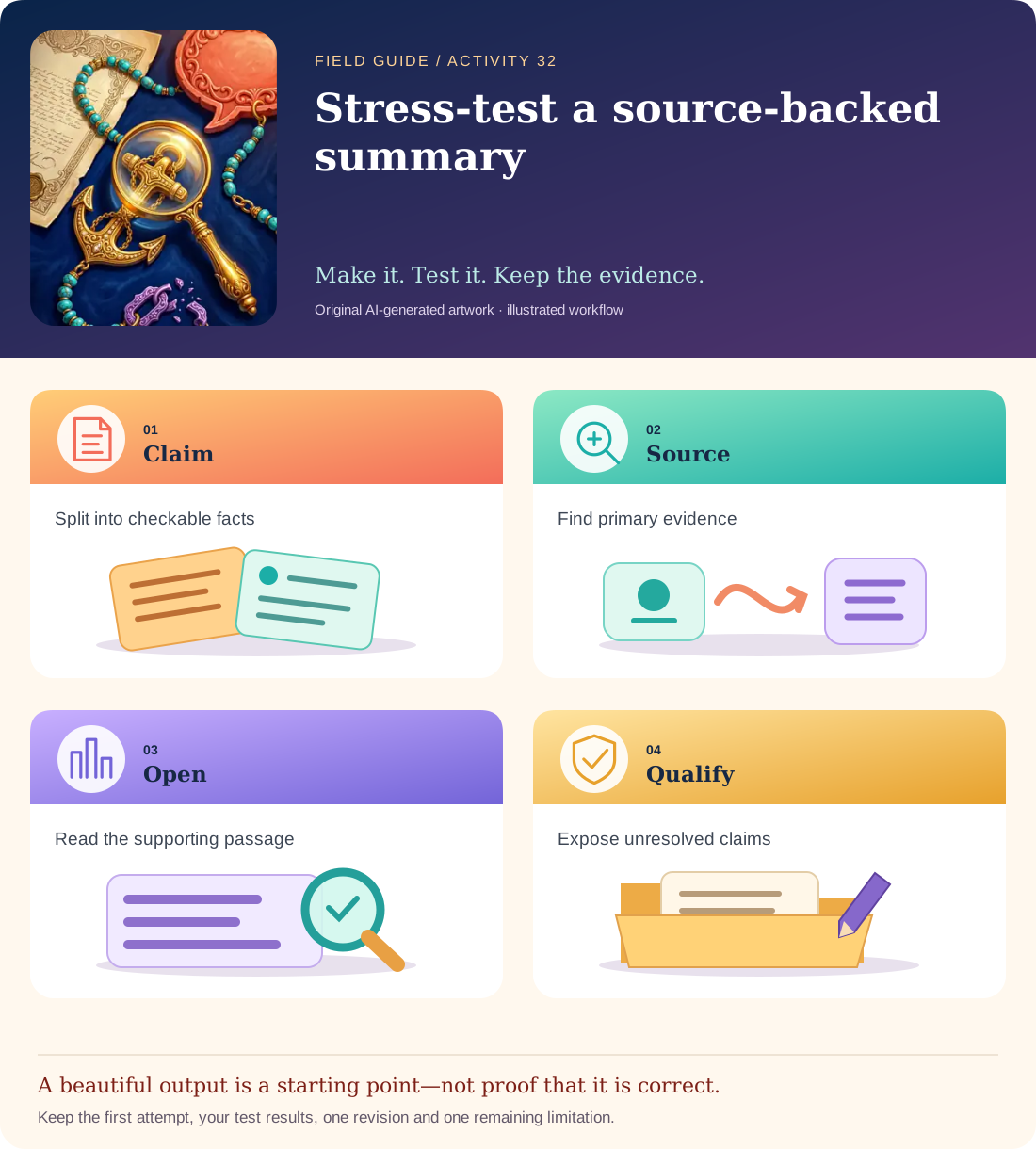
Conceptual illustration, not a provider screenshot. Artwork is AI-generated; instructional labels are authored text.
Start with fictional input
Fictional notice A, issued 20 October: “The community hall repair event is scheduled for 28 October, 10:00–13:00. Registration is required. Capacity is 40.” Notice B: “An earlier draft listed 27 October; that date is superseded.” These are fixtures, not real news.
Copy and adapt this prompt
Using only supplied sources, write three factual sentences with source labels and exact supporting quotations. Separate event date from publication date. State contradictions or corrections. If using live web sources instead, give a direct primary-source URL per claim and mark anything you could not open or verify.
Worked reference—not proof of correctness
Supported: the fictional event is on 28 October, not 27 October. Capacity is 40. Registration is required. Unsupported: “40 people have already registered.” Capacity and actual attendance are different claims.
Five practical steps
Choose live or fixture mode
Record which route you are using. Live mode needs current primary-source pages you can open.
Extract atomic claims
Split date, time, capacity and registration into separate claims.
Request the summary
Require source labels/links and short supporting quotes.
Open and inspect
For each live citation, check source ownership, publication/update date and the exact supporting passage.
Record unresolved items
Remove claims whose sources fail, or label them unverified; do not silently replace them with guesses.
Test your result
- Every retained claim has directly supporting evidence, not merely a related link.
- Publication date, event date, capacity and attendance are not conflated.
- Fixture mode never claims to be live reporting or web verification.
Mistakes to watch for
- Treating a real-looking link as proof of the adjacent claim.
- Inventing last-week news when the tool has no current search capability.
Offline / no-key route
Use the supplied labelled notices and build the same claim-evidence ledger; it is not a live-news exercise.
Reflect
Which sentence looked cited but was not actually supported?
Keep your notes, tests and self-review →Self-reported practice is not independent assessment or a qualification. Browse all 50 guides · Choose a tool