
A three-frame story with continuity
Translate a short narrative into consistent visual briefs and inspect change across frames.
60 minutes estimated—not learner-validated. Original learning materials are free; optional external AI access may require an account, credits or payment.
Start the editable activity →No account needed to begin. Explicit account saving and editable offline export are available in the workspace.
New here? Try the three-activity starter ↗
Why this matters
Separate the story’s changing action from its fixed character and setting details. Repeating a style phrase does not guarantee continuity; reference-image support and controls vary by tool. Use an original fictional character, no real likeness, and keep all three frames as separate artifacts with a continuity ledger.
Before you start
Materials are free. External tools may require an adult account, credits, regional eligibility or a paid plan. Check current terms before using them. Do not paste passwords, API keys, private messages or other people’s personal data. No model runs locally or downloads automatically on this platform.
Your illustrated field guide
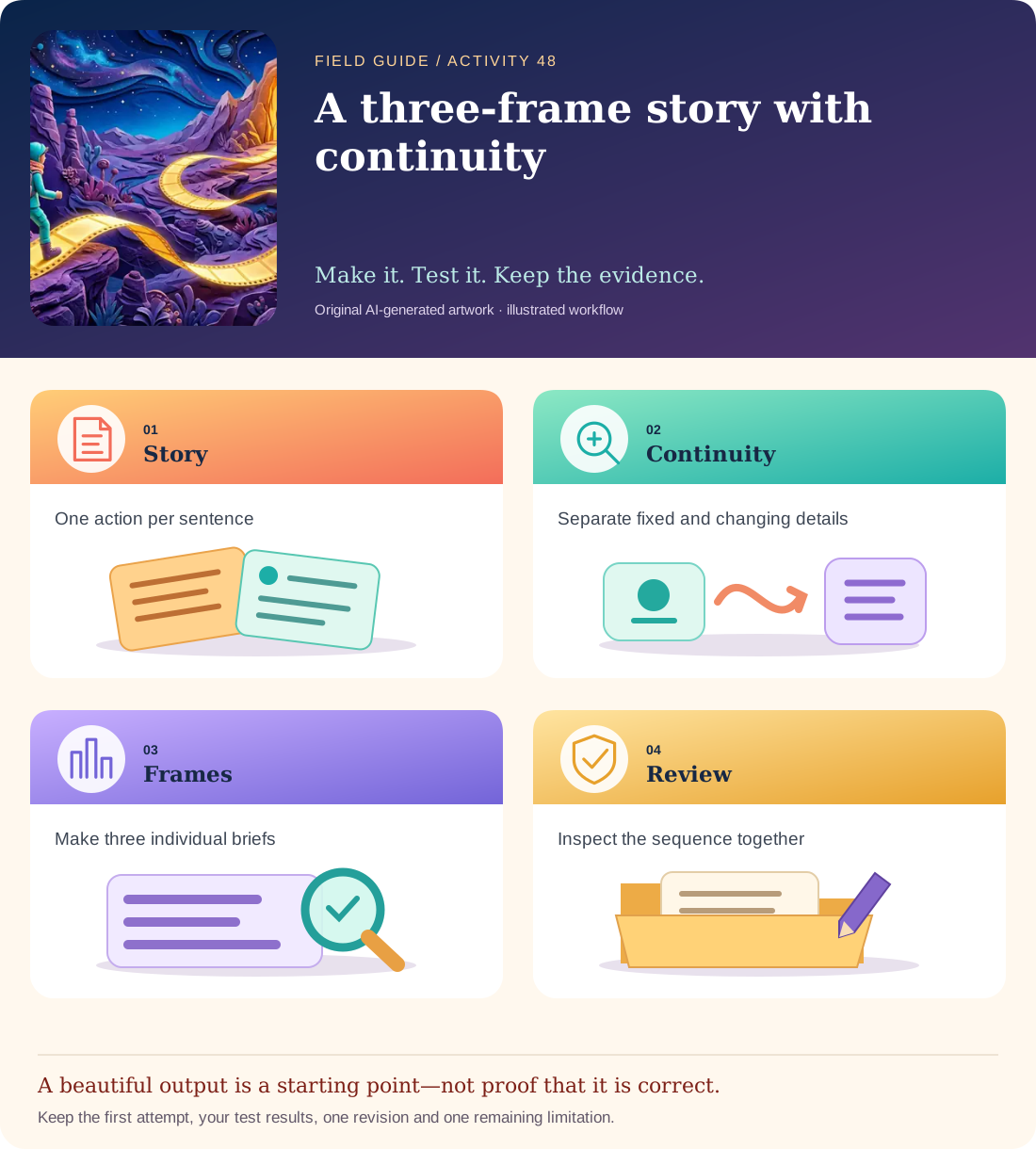
Conceptual illustration, not a provider screenshot. Artwork is AI-generated; instructional labels are authored text.
Start with fictional input
Original story: A small orange maintenance robot finds a seed on a rooftop. It plants the seed in a cracked blue pot. At sunrise it shelters the first leaf from the wind. Fixed details: round body, one square eye, blue pot, same rooftop; no logos or writing.
Copy and adapt this prompt
Create three separate frame briefs, one per sentence. For each list fixed character/prop details, action, camera view and light. Use one coherent hand-drawn editorial style. Do not change the robot’s eye, pot colour or rooftop between frames. Do not claim that prompt repetition guarantees visual consistency.
Worked reference—not proof of correctness
Continuity ledger: robot round/orange/one square eye in all frames; pot blue once introduced; same rooftop edges. The action and time/light may change. A second eye or red pot is a continuity error, not a new story fact.
Five practical steps
Write the three sentences
Keep the plot simple enough to show one action per frame.
Make a continuity sheet
Separate permanent character/setting features from allowed changes.
Draft three briefs
Require fixed details in each brief; avoid copying a known fictional franchise.
Generate or draw separately
Use a permitted reference workflow if available; otherwise record the lack of identity controls.
Review as a sequence
Compare all fixed features and note at least one correction before presenting the story.
Test your result
- There are three separately described frames with one clear action each.
- Fixed robot, prop and setting details are checked across the sequence.
- The report documents continuity failures and actual controls used rather than promising perfect consistency.
Mistakes to watch for
- Treating style consistency as character consistency.
- Using a real person’s likeness or a recognizable character without permission.
Offline / no-key route
Draw three thumbnail frames from the continuity sheet and have a reader reconstruct the story.
Reflect
Which small visual inconsistency changed the story’s meaning?
Keep your notes, tests and self-review →Self-reported practice is not independent assessment or a qualification. Browse all 50 guides · Choose a tool