
Reverse-engineer a writing blueprint
Describe the structure of a text and use it to write an original piece.
35 minutes estimated—not learner-validated. Original learning materials are free; optional external AI access may require an account, credits or payment.
Start the editable activity →No account needed to begin. Explicit account saving and editable offline export are available in the workspace.
New here? Try the three-activity starter ↗
Why this matters
A model cannot recover the exact hidden prompt that created an article. It can propose a plausible blueprint: audience, structure, tone, evidence and length. Analyse a text you own or have permission to use, then apply its abstract structure to a different topic rather than copying its expression.
Before you start
Materials are free. External tools may require an adult account, credits, regional eligibility or a paid plan. Check current terms before using them. Do not paste passwords, API keys, private messages or other people’s personal data. No model runs locally or downloads automatically on this platform.
Your illustrated field guide
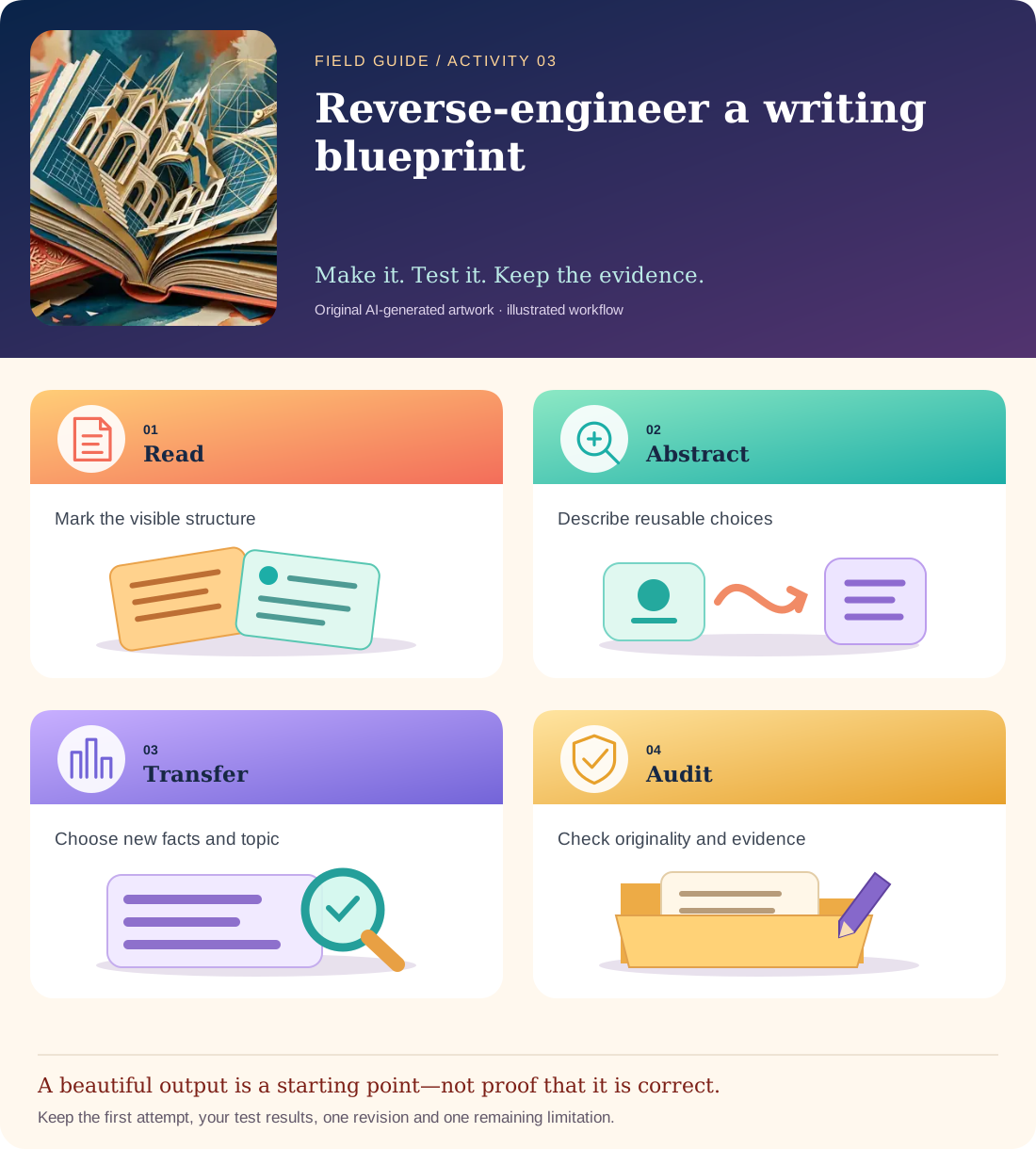
Conceptual illustration, not a provider screenshot. Artwork is AI-generated; instructional labels are authored text.
Start with fictional input
Original sample: “Start small. Our weekend repair table began with three broken lamps and a borrowed screwdriver. By Sunday, neighbours had fixed two lamps and learned when to call an electrician. Bring a simple item next month; leave dangerous wiring to a professional.”
Copy and adapt this prompt
Analyse this original sample. List its audience, hook, paragraph structure, sentence rhythm, evidence and closing action. Then write a reusable prompt for a NEW article on a different subject. Do not claim to know the original prompt, copy distinctive sentences or imitate a living writer by name.
Worked reference—not proof of correctness
Blueprint: short imperative hook → concrete small-scale story → modest outcome with a limitation → safe invitation. New topic: a neighbourhood seed exchange. The new article should not reuse lamps, screwdrivers or the original opening phrase.
Five practical steps
Annotate the sample
Highlight the hook, concrete evidence, safety boundary and closing invitation in different colours.
Ask for a blueprint
Use the prompt and mark which observations are actually visible in the source.
Choose a new topic
Use a seed exchange or book swap, supplying your own fictional facts rather than asking for invented statistics.
Generate a fresh draft
Give the blueprint and new facts in a separate request. Compare structure, not matching phrases.
Audit originality
Flag repeated distinctive phrases and unsupported claims. Rewrite one paragraph yourself.
Test your result
- Every structural observation can be pointed to in the sample.
- The new draft uses different subject matter and does not recycle distinctive sentences.
- The answer describes a plausible blueprint, not “the exact original prompt.”
Mistakes to watch for
- Requesting a near-identical copyrighted article.
- Assuming the model’s explanation reveals its internal thought process.
Offline / no-key route
Make a five-box outline by hand and write a new piece from it; this is a structure exercise, not proof of AI provenance.
Reflect
Which structural feature was transferable without copying the original wording?
Keep your notes, tests and self-review →Self-reported practice is not independent assessment or a qualification. Browse all 50 guides · Choose a tool