
One scene, three visual styles
Control a visual experiment by changing only the style instruction.
45 minutes estimated—not learner-validated. Original learning materials are free; optional external AI access may require an account, credits or payment.
Start the editable activity →No account needed to begin. Explicit account saving and editable offline export are available in the workspace.
New here? Try the three-activity starter ↗
Why this matters
Image generators are stochastic: a different result may come from randomness rather than style alone. Keep the subject, camera, layout and constraints fixed. Where supported, record seed/model/settings; if not supported, repeat each condition and state the limitation. Compare separate original images rather than assuming a grid is a controlled experiment.
Before you start
Materials are free. External tools may require an adult account, credits, regional eligibility or a paid plan. Check current terms before using them. Do not paste passwords, API keys, private messages or other people’s personal data. No model runs locally or downloads automatically on this platform.
Your illustrated field guide
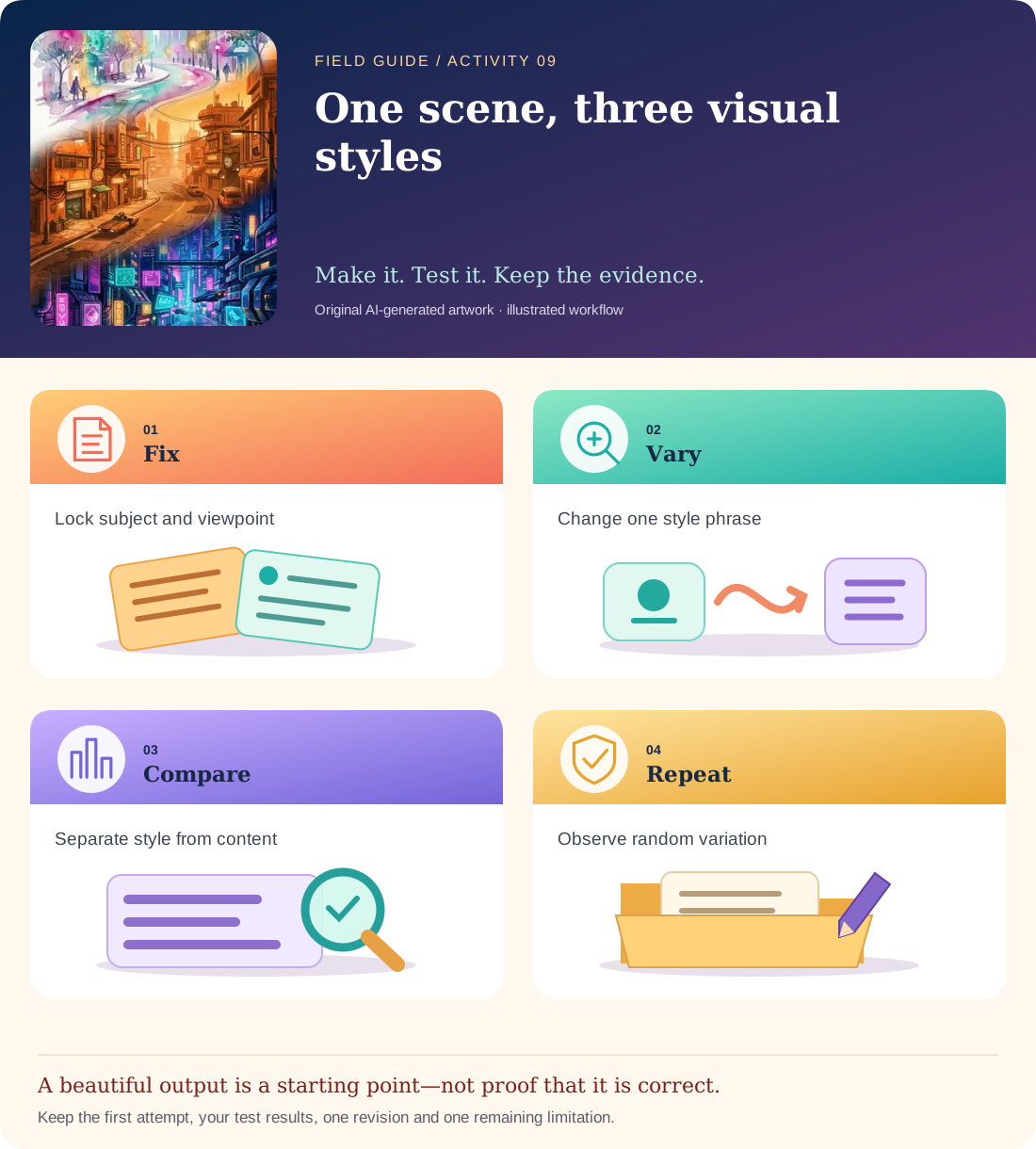
Conceptual illustration, not a provider screenshot. Artwork is AI-generated; instructional labels are authored text.
Start with fictional input
Core scene: an empty pedestrian street at dawn, one bicycle beside a bakery window, eye-level camera, no readable signs, no logos or people. Styles: neon-influenced cyberpunk illustration; muted 1970s film photograph; loose watercolor painting.
Copy and adapt this prompt
Generate the core scene exactly as specified, preserving the bicycle position, eye-level viewpoint and empty street. Apply only this style modifier: [one of the three styles]. No text, logos or recognizable real businesses.
Worked reference—not proof of correctness
A comparison sheet can record: bicycle retained? one bakery window? empty street? eye-level view? palette? texture? A watercolor output that adds a crowded market fails the fixed-scene requirement even if its painting style is attractive.
Five practical steps
Write fixed constraints
List four scene elements that must not change. Use an original fictional setting.
Run three conditions
Generate one image per style with the same core prompt. Record provider, model and settings where visible.
Compare observable features
Score fixed-element retention separately from palette, lighting and surface texture.
Repeat a condition
Regenerate one style. Note how much variation happens without changing the style text.
Refine one constraint
Improve the weakest scene-preservation rule and compare before/after outputs.
Test your result
- Three separate outputs share the same written core prompt and differ only in the style modifier.
- Your comparison scores composition retention separately from visual style.
- The repeat run documents randomness or seed control rather than claiming causation from one sample.
Mistakes to watch for
- Changing composition and style simultaneously.
- Using a living artist’s name instead of describing visual attributes.
Offline / no-key route
Draw three small scene thumbnails or annotate a licensed original scene using different colour/texture notes. Mark the work as a storyboard, not generated imagery.
Reflect
Which difference can you reasonably attribute to style, and which might be random?
Keep your notes, tests and self-review →Self-reported practice is not independent assessment or a qualification. Browse all 50 guides · Choose a tool