
Turn a synthetic focus group into a real test plan
Use varied constraints to brainstorm hypotheses while avoiding fake participants and reactions.
35 minutes estimated—not learner-validated. Original learning materials are free; optional external AI access may require an account, credits or payment.
Start the editable activity →No account needed to begin. Explicit account saving and editable offline export are available in the workspace.
New here? Try the three-activity starter ↗
Why this matters
A model cannot reveal what real people subconsciously think. Simulated personas are a brainstorming aid shaped by the prompt, not representative research or testimonials. Vary relevant needs such as time, readability and trust instead of relying on demographic stereotypes. Design a real consented test to evaluate the hypotheses.
Before you start
Materials are free. External tools may require an adult account, credits, regional eligibility or a paid plan. Check current terms before using them. Do not paste passwords, API keys, private messages or other people’s personal data. No model runs locally or downloads automatically on this platform.
Your illustrated field guide
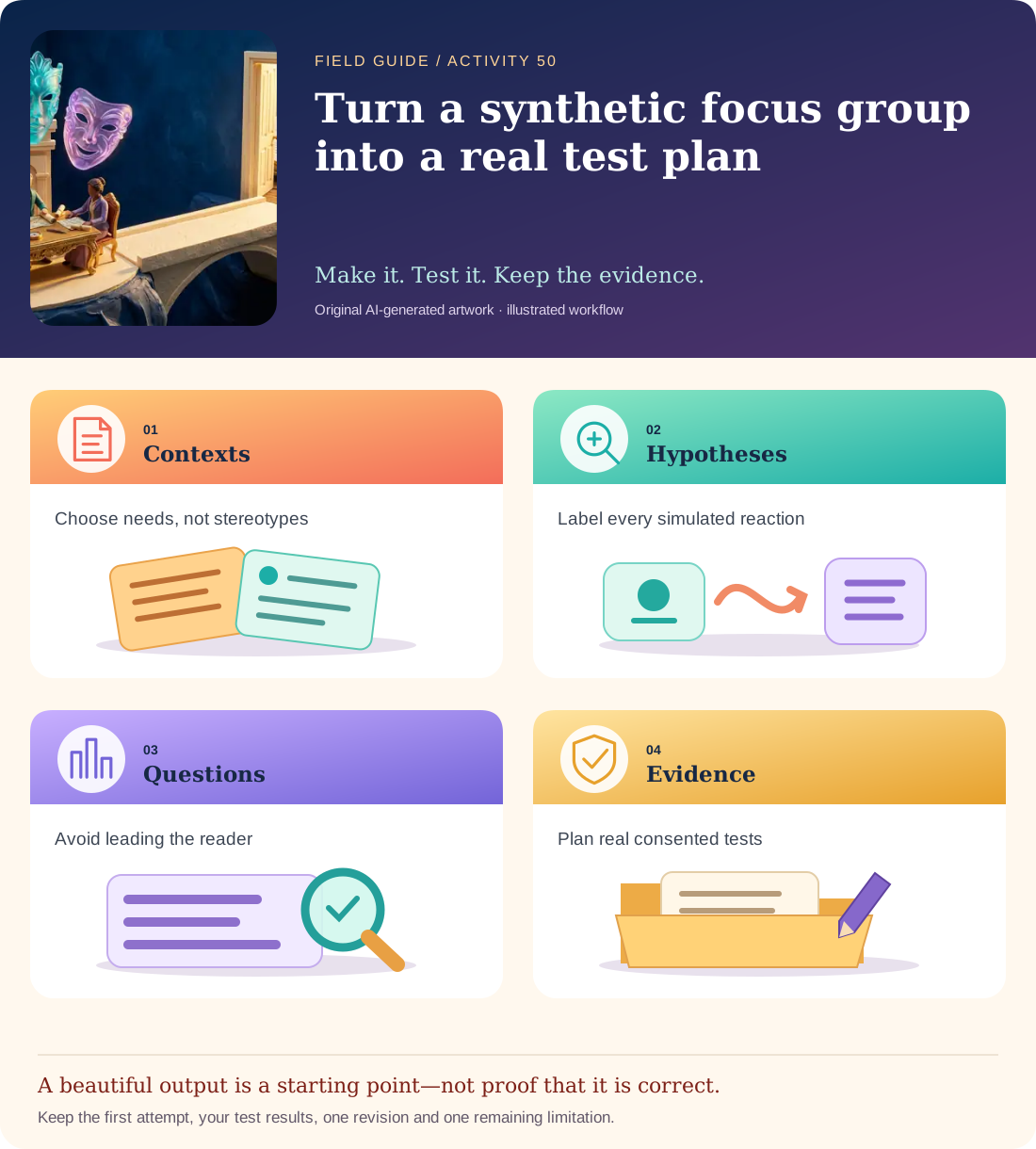
Conceptual illustration, not a provider screenshot. Artwork is AI-generated; instructional labels are authored text.
Start with fictional input
Fictional slogan: “One small build. One useful skill.” Test contexts: a rushed first-time learner; a reader using a small phone with low bandwidth; a cautious learner concerned about credentials and privacy. No person has actually reviewed the slogan.
Copy and adapt this prompt
Generate possible reactions for these three fictional contexts. Label every reaction Hypothesis, not a quote from a participant. For each, list a neutral question and an observable test. Do not infer subconscious feelings, population preferences or purchase intent. Do not invent survey counts or ratings.
Worked reference—not proof of correctness
Hypothesis: “useful skill” may feel too vague. Neutral question: “What would you expect to do after reading this?” Observable test: ask consented readers to describe the expected activity before showing the course list. Three simulated reactions are not three participants.
Five practical steps
Define relevant contexts
Use task constraints rather than stereotypes about age, gender or occupation.
Generate labelled hypotheses
Keep the fictional nature visible on every reaction.
Write neutral questions
Avoid asking whether the reader likes your preferred wording.
Plan an observable task
Choose what a real reader will do or explain and decide how to record consent and feedback.
Report honestly
Keep simulation notes separate from any later human evidence, including sample limits and negative feedback.
Test your result
- All synthetic reactions are labelled hypotheses with no invented participant quotes or counts.
- Each context produces a neutral question and an observable test.
- The final plan separates brainstorming from actual consented user research.
Mistakes to watch for
- Reporting a synthetic focus group as representative market evidence.
- Attributing hidden psychological reactions to demographic stereotypes.
Offline / no-key route
Brainstorm the three context-based hypotheses yourself and write the same real-user test plan.
Reflect
What result from real readers would make you abandon the slogan?
Keep your notes, tests and self-review →Self-reported practice is not independent assessment or a qualification. Browse all 50 guides · Choose a tool