
Translation without false confidence
Use independent checks to identify meaning changes and unresolved ambiguity.
35 minutes estimated—not learner-validated. Original learning materials are free; optional external AI access may require an account, credits or payment.
Start the editable activity →No account needed to begin. Explicit account saving and editable offline export are available in the workspace.
New here? Try the three-activity starter ↗
Why this matters
Back-translation can expose problems, but two fluent translations can share the same error. Choose a non-sensitive text with numbers, negation, dates and an idiom. A bilingual human or authoritative glossary remains necessary for high-stakes use. Do not approve a translation solely because it comes back sounding plausible.
Before you start
Materials are free. External tools may require an adult account, credits, regional eligibility or a paid plan. Check current terms before using them. Do not paste passwords, API keys, private messages or other people’s personal data. No model runs locally or downloads automatically on this platform.
Your illustrated field guide
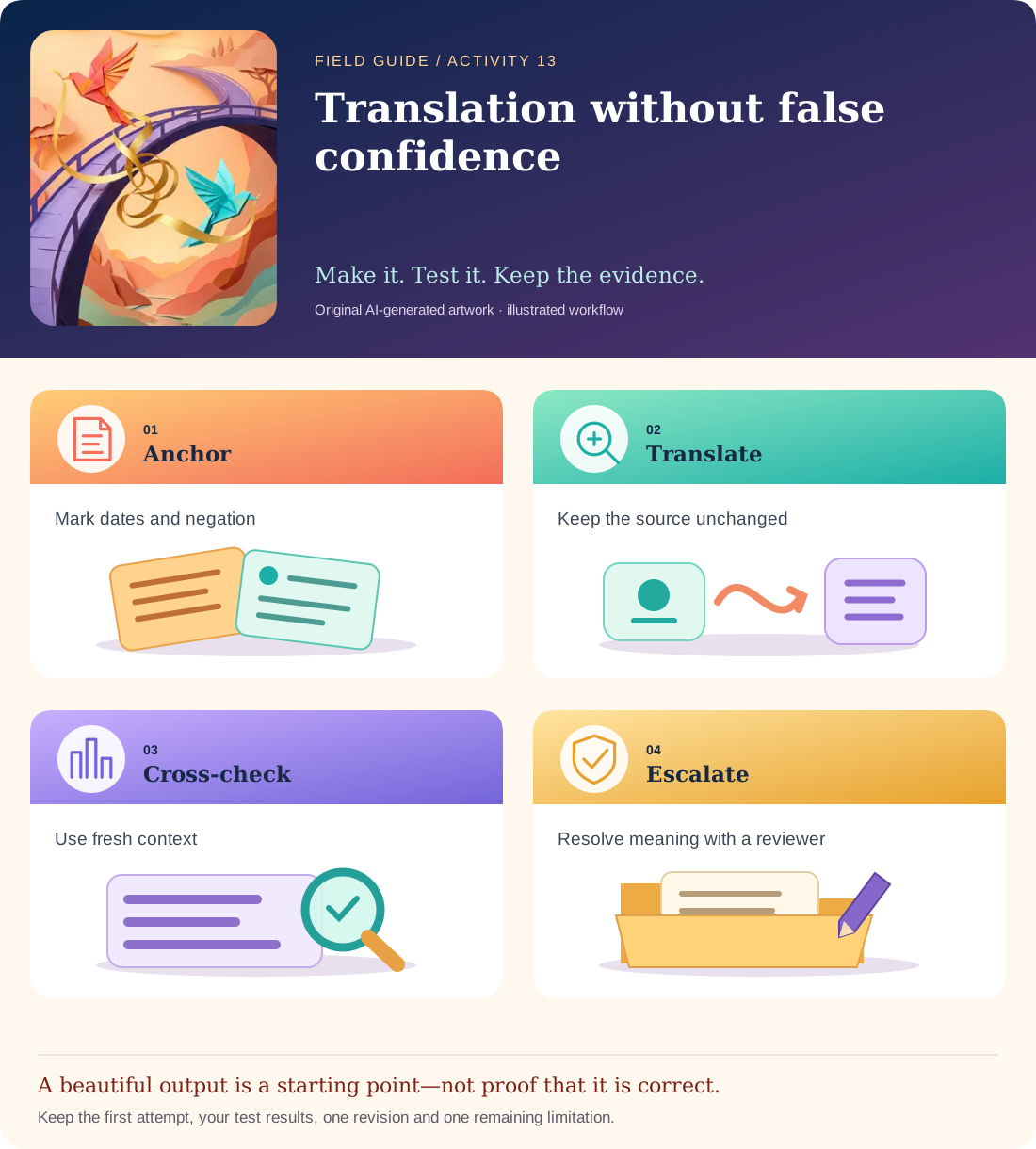
Conceptual illustration, not a provider screenshot. Artwork is AI-generated; instructional labels are authored text.
Start with fictional input
Original: “Please do not ship before 6 November. Send 12 blue mugs, not 21. ‘Break a leg’ in the final line is a friendly wish, not an injury instruction.”
Copy and adapt this prompt
Translate the supplied message into a language you can responsibly review. Preserve the date, quantity, negation and colour. Explain the idiom separately. In a fresh chat, translate the result back to English and list any ambiguous phrases. Do not certify the translation.
Worked reference—not proof of correctness
Check ledger: no shipment before 6 November; quantity 12; blue; exclusion of 21; idiom means good luck. If the return translation says “ship by 6 November,” it has reversed an operational constraint despite fluent wording.
Five practical steps
Mark invariants
Write a checklist of date, quantity, negation, colour and idiom before translating.
Create a translation
Keep the source and target text unchanged for comparison.
Use a fresh check
Back-translate in a separate context; if possible use an independent service rather than the same model.
Inspect each invariant
Record pass, fail or unresolved. Consult a bilingual reader or authoritative glossary for disputed language.
Prepare a safe handoff
Mark unresolved wording and state “not approved for contractual or safety-critical use.”
Test your result
- All five meaning constraints are checked individually rather than judged on fluency.
- A changed before/by instruction is flagged as a material failure.
- The report states the limits of back-translation and names unresolved review needs.
Mistakes to watch for
- Assuming two AI systems are independent evidence of correctness.
- Using an unfamiliar language without a competent human review route.
Offline / no-key route
Use two English paraphrases and inspect whether they preserve the same constraints. Label this a meaning-preservation exercise, not a translation test.
Reflect
What important error could a fluent back-translation still miss?
Keep your notes, tests and self-review →Self-reported practice is not independent assessment or a qualification. Browse all 50 guides · Choose a tool