
Chain a visual brief without losing control
Turn a descriptive idea into a concise image brief, then inspect instruction drift.
45 minutes estimated—not learner-validated. Original learning materials are free; optional external AI access may require an account, credits or payment.
Start the editable activity →No account needed to begin. Explicit account saving and editable offline export are available in the workspace.
New here? Try the three-activity starter ↗
Why this matters
More descriptive text can create conflicting priorities. A text model’s elaborate scene is a draft brief, not a command the image generator will obey perfectly. Protect a few non-negotiable elements, reduce decorative overload and compare actual images against a stable checklist. Use original concepts rather than recognizable franchise settings.
Before you start
Materials are free. External tools may require an adult account, credits, regional eligibility or a paid plan. Check current terms before using them. Do not paste passwords, API keys, private messages or other people’s personal data. No model runs locally or downloads automatically on this platform.
Your illustrated field guide
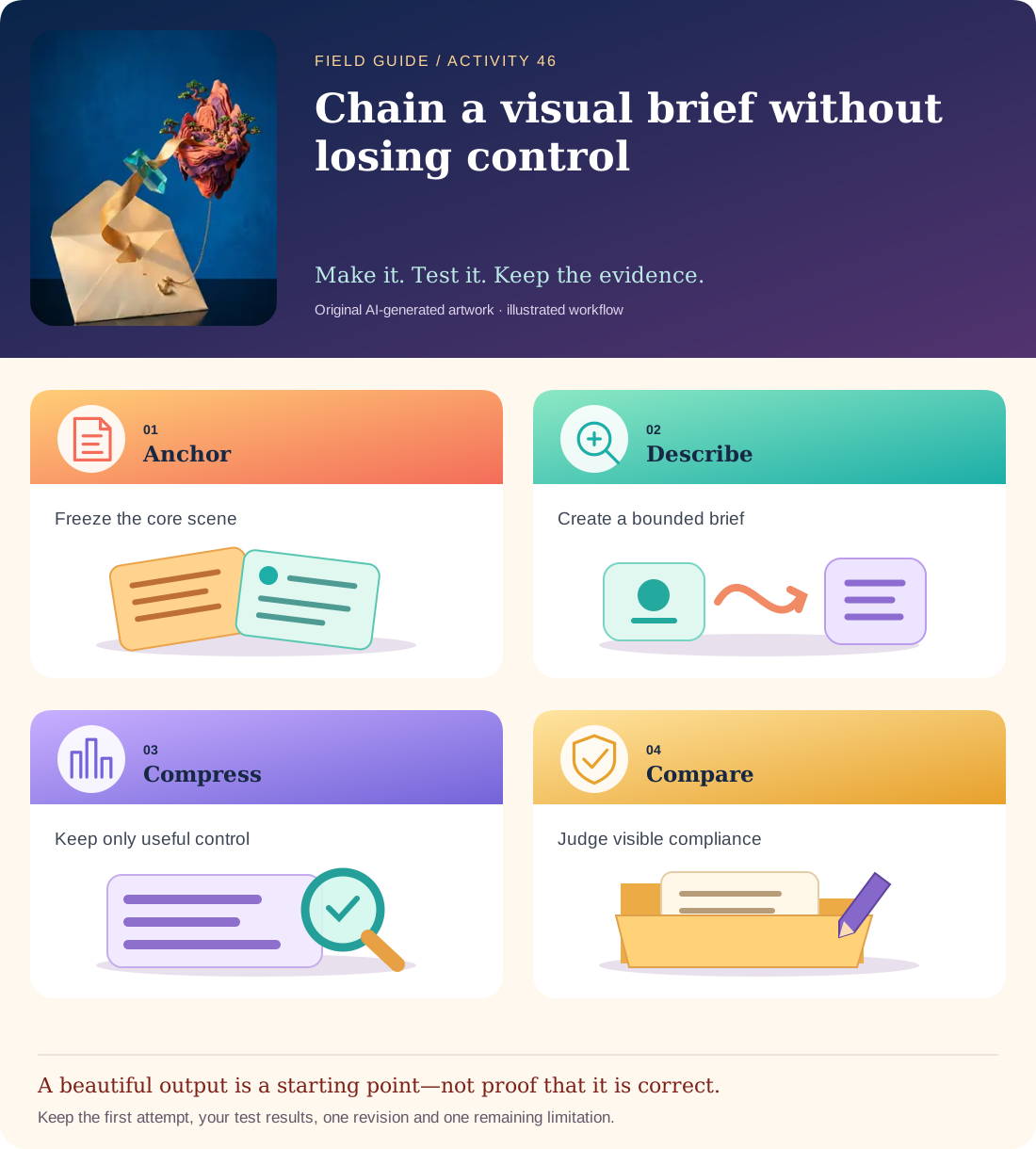
Conceptual illustration, not a provider screenshot. Artwork is AI-generated; instructional labels are authored text.
Start with fictional input
Original scene requirements: one floating garden island, one footbridge, a small waterfall, daylight and open sky. No buildings, people, writing or branded characters. Desired mood: quiet and welcoming.
Copy and adapt this prompt
Write an image brief of at most 120 words using the supplied requirements. Separate subject, composition, lighting, palette and exclusions. Do not add new objects or a hidden story. Then compress it to 45 words while preserving the same fixed elements.
Worked reference—not proof of correctness
A verbose brief that adds towers and crowds has drifted from the requirements. The short and long versions should both retain one island, one bridge, a waterfall, daylight and the exclusions. Actual image compliance must be scored separately from prose quality.
Five practical steps
Freeze core elements
Write the five required elements and exclusions as a scorecard.
Draft the long brief
Use the text prompt and remove additions not authorized by the original idea.
Create the short brief
Keep the same requirements with fewer modifiers.
Generate and compare optionally
Use one image per brief in the same provider/model; record settings and variation limits.
Revise from evidence
Change the brief because of a visible failure, not merely because a longer sentence sounds richer.
Test your result
- Both textual briefs preserve required elements and exclusions without extra objects.
- The long brief is within 120 words and the short one within 45.
- If images are generated, their visible compliance is scored separately from the descriptions.
Mistakes to watch for
- Assuming a dense brief gives more precise control.
- Allowing each stage to add objects until the final scene no longer matches the original task.
Offline / no-key route
Write the two briefs and sketch thumbnail compositions, marking which required elements survived.
Reflect
Which decorative phrase could you remove without losing a meaningful instruction?
Keep your notes, tests and self-review →Self-reported practice is not independent assessment or a qualification. Browse all 50 guides · Choose a tool