
Direct a spoken explanation
Compare voice delivery while keeping script, consent and meaning constant.
45 minutes estimated—not learner-validated. Original learning materials are free; optional external AI access may require an account, credits or payment.
Start the editable activity →No account needed to begin. Explicit account saving and editable offline export are available in the workspace.
New here? Try the three-activity starter ↗
Why this matters
Voice style affects perceived confidence but does not make the script accurate. Use generic licensed synthetic voices, never an unconsented clone. Write a short verified script, hold its words fixed, and compare intelligibility, pauses and pronunciation. Provider availability and free allowances vary.
Before you start
Materials are free. External tools may require an adult account, credits, regional eligibility or a paid plan. Check current terms before using them. Do not paste passwords, API keys, private messages or other people’s personal data. No model runs locally or downloads automatically on this platform.
Your illustrated field guide
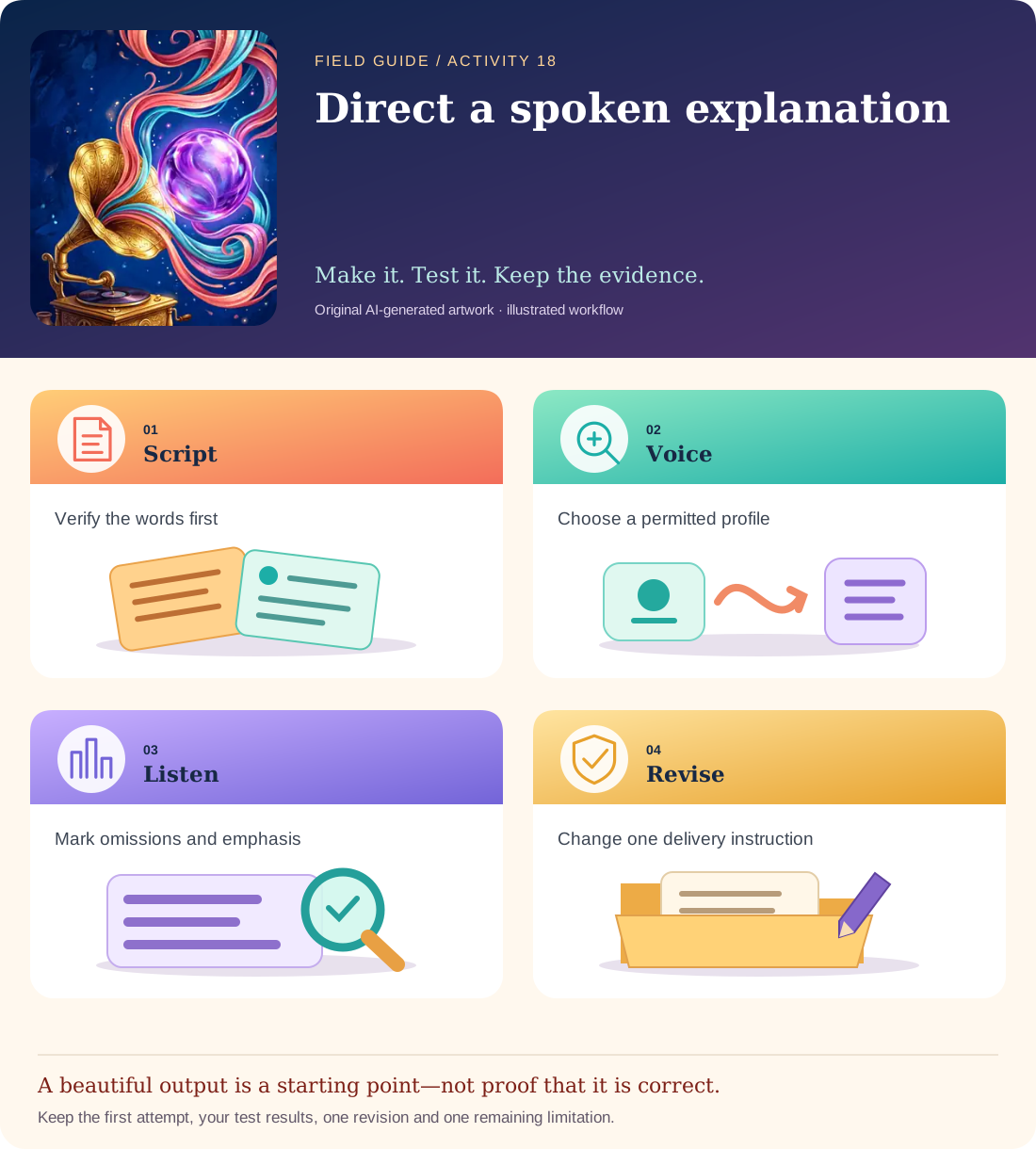
Conceptual illustration, not a provider screenshot. Artwork is AI-generated; instructional labels are authored text.
Start with fictional input
Original script: “A backup is a separate copy you can restore when the original is lost. A copy in the same folder may disappear with the same device. Keep a separate copy, protect access, and test that you can restore it.”
Copy and adapt this prompt
Read this script in a calm, clear educational style. Keep every word unchanged. Pause at sentence boundaries and pronounce “backup” consistently. Do not add music, claims, names or a cloned person’s voice. [Paste script.]
Worked reference—not proof of correctness
A review table can rate calm / energetic / storytelling voices on word accuracy, clarity and unwanted additions. A dramatic delivery that changes “may disappear” to “will always disappear” fails even if listeners prefer the sound.
Five practical steps
Check the script
Verify the meaning first and remove personal information. Time yourself reading it aloud.
Select permitted voices
Use three generic licensed profiles if available, or two profiles plus your own reading; note the actual route.
Generate separate clips
Keep the exact script and roughly comparable speed; save settings and tool labels.
Listen and annotate
Mark mispronunciations, missing words, misleading emphasis and long pauses against the transcript.
Revise the direction
Change one delivery instruction and compare the new clip; retain an accessible text transcript.
Test your result
- All clips use the same script and have a readable transcript.
- The chosen voice is generic/licensed or your own, with no unconsented identity cloning.
- Your comparison measures wording and intelligibility separately from personal preference.
Mistakes to watch for
- Mistaking a confident voice for trustworthy content.
- Using a celebrity or colleague’s voice without permission.
Offline / no-key route
Record yourself delivering the same script in three styles, or annotate three read-aloud directions without generating audio.
Reflect
Which delivery changed what a listener might believe even though the words stayed similar?
Keep your notes, tests and self-review →Self-reported practice is not independent assessment or a qualification. Browse all 50 guides · Choose a tool